The Best Phone and Camera Gimbals for 2026
The gimbal market just reshuffled. PCMag's mid-2026 update adds the Insta360 Luna Ultra to its Editors' Choice slate and drops the Zhiyun Crane 2S, now confirmed discontinued.
Three-axis stabilization: what the current picks deliver
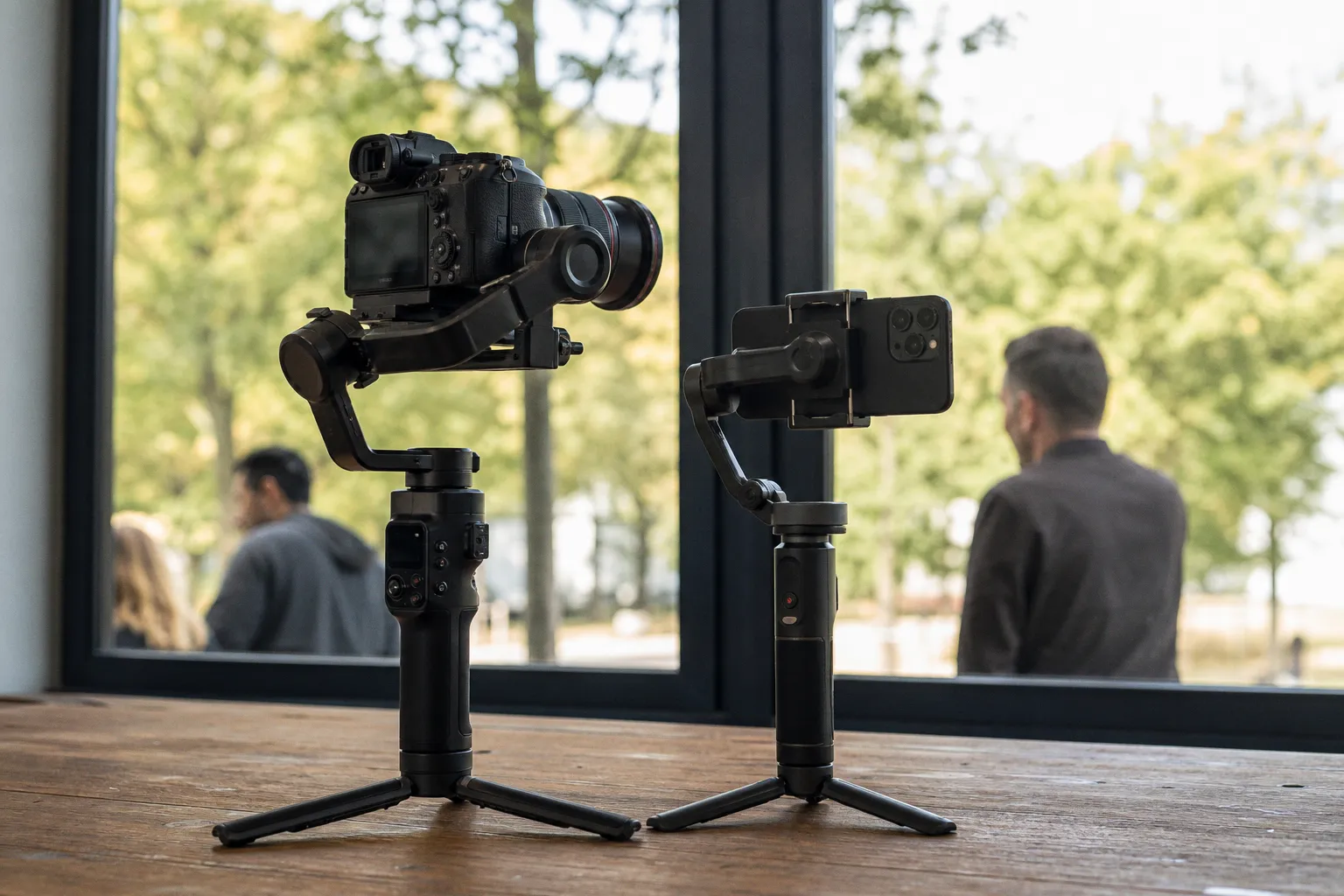
Every model on the updated list runs a three-axis brushless motor system. That's the baseline. No exceptions. The motors handle pan, tilt, and roll, countering operator movement frame by frame. Setup requires centering the camera and dialing in balance before the motors even engage—expect roughly 15 minutes of calibration per session, per PCMag's testing notes. After that, the system holds steady. Noise floor from the motors is reported as negligible, though real-world thermal behavior under sustained loads isn't broken out in the current data.
The DJI RS 4 targets mirrorless rigs. Payload capacity matters here: if your body-plus-lens kit exceeds the gimbal's rated maximum, motor performance drops and stabilization degrades. The source doesn't list exact payload figures for the RS 4, so cross-reference the manufacturer's spec sheet before mounting a full-frame body with a fast zoom.
Smartphones vs. dedicated cameras: two different engineering problems
Phone gimbals like the Osmo Mobile 7P face a different constraint set. No interchangeable lenses. No heavy bodies. The motors are smaller, the payload ceiling lower, but the integration with smartphone control apps is tighter—Bluetooth pairing, USB camera control, and wireless video transmission are standard on advanced models. The Luna Ultra sidesteps this entirely by embedding the camera into the gimbal itself, eliminating the balance step and the payload variable. Trade-off: you're locked into Insta360's sensor and optics.
Battery architecture splits two ways across the category. Some units embed the cell in the handle—lighter, cleaner profile, but when capacity fades, the entire gimbal is a write-off. Others ship with swappable battery packs. PCMag notes long run times across the board and USB charging as standard, but doesn't quantify cycle life or degradation curves. If you're running daily shoots, the swappable option likely pencils out cheaper over a two-year horizon.
Price and payload: the numbers that matter
Entry cost sits at roughly $100 for a smartphone gimbal. Full-frame-capable rigs climb toward $1,000. The scaling is linear with payload capacity and feature set—motion-lapse, 360-degree roll modes, and motorized focus drives sit on the premium end. The Crane 2S's exit from the market removes one mid-tier option, narrowing the field slightly for operators in the $400–$600 bracket.
One operational note: lens selection affects gimbal performance more than most realize. Large, front-heavy glass shifts the center of gravity and taxes the motors. If you're shooting on a gimbal regularly, match your lens kit to the payload spec, not the other way around.