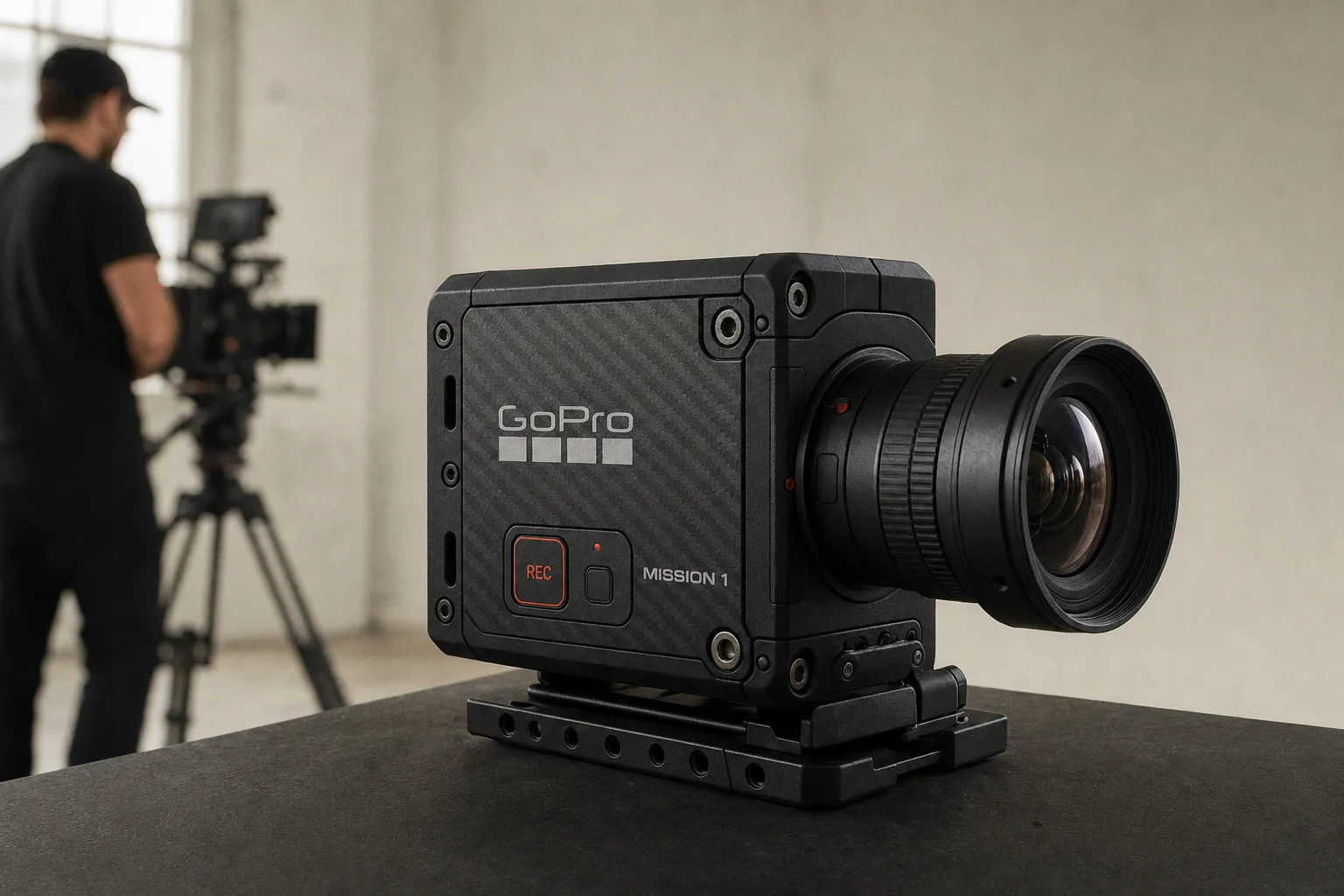
Video Equipment Market Outlook Highlights Strategic Opportunities Across The Industry
The global camera stabilizer market is projected to grow from $3.35 billion in 2025 to $3.57 billion in 2026, at a 6.4% CAGR, according to a Business Research Company forecast distributed via EIN Presswire.
Revenue versus mechanical fidelity
The near-term growth attribution lists five drivers: professional film production demand, the residual analog-to-digital transition, broadcast infrastructure expansion, consumer action camera adoption, and incremental mechanical stabilization advances. The forecast period through 2030 adds five more: social media video volume, mobile filmmaking kits, battery life gains in portable units, live streaming growth, and lower-cost motorized gimbals.
What's absent: any quantification of axis-count tolerance improvements, payload-to-weight ratios, encoder resolution, or follow-focus repeatability. The metric under measurement is revenue, not footage quality. A 6.4% CAGR captures market velocity. It does not capture optical or mechanical fidelity — and those are the variables that determine whether a shot holds up under delivery.
Where manufacturer claims diverge from specs
"Smoothness" and "pro-grade stability" claims from manufacturers are typically characterized under ideal lab conditions — degrees of axis deviation, vibration isolation thresholds, drift at static load over fixed intervals. The Business Research Company forecast tracks units shipped and dollars moved. It does not track mechanical tolerances.
Entry-level consumer gimbals targeting smartphone-first workflows are flagged as a growth segment. The implication: wider SKU count, broader tolerance variance, thinner QA margins. Carbon fiber support systems appear as an emerging trend. On the spec sheet, that translates to lower payload ceilings and reduced vibration damping at the handle-to-arm junction unless counterbalanced. Operators running 4–8 kg payloads should verify claimed weight savings against documented stiffness figures, not brochure copy.
Operating notes for gear procurement
- Sub-$1,500 motorized 3-axis gimbals: expect annualized price compression through 2030, given the projected 6.7% CAGR.
- Smartphone-first stabilizers: SKU expansion, not necessarily performance envelope expansion. Confirm axis deviation specs before assuming parity with mid-range traditional units.
- Carbon fiber trends: verify stiffness data independently, particularly above 5 kg payload.
- Battery life: flagged as a forecast driver — wait for third-party cycle testing rather than manufacturer-rated hour counts.
- The openPR.com headline running in parallel — "Video Equipment Market Outlook Highlights Strategic Opportunities Across The Industry" — carries no source text or verifiable methodology in the available snippet. Treat as a directional signal only.