There is a number printed on every V-mount battery that decides whether it boards the plane with you.
5 V-Mount Battery Specs to Compare for Airline Carry-On
The five specs below are the ones I read on every V-mount before it goes near an airport. This is the same scan I run when I am wheeling six packs of mixed vintage through a sound cart. Power is not an afterthought. Neither should the rulebook be.
The watt-hour rating is the most consequential number on the entire label. It outranks brand, marketing, and "airline safe" packaging claims by a wide margin.
Decoding the Watt-Hour Rating on a V-Mount Casing
Every V-mount I have ever bought, borrowed, or fished out of a rental house has its capacity expressed somewhere in watt-hours, not in amp-hours, not in mAh, not in vague "high capacity" copy. Watt-hours are the lingua franca of every regulator on the planet. They describe the actual stored energy a cell can deliver.
1 Wh equals 1 watt of draw sustained for one hour. A 98Wh battery powers a 50W LED panel for just under two hours, or an on-camera monitor for the better part of a day. A 156Wh battery doubles that headroom. Regulators care about watt-hours because that is the figure that maps to worst-case thermal runaway in a fault condition. The higher the Wh, the tighter the rulebook, and the less room you have to argue at the belt.
Here is what you need to be able to find on the label, in order:
- The Wh figure itself, typically printed next to the nominal voltage (e.g., "14.4V, 98Wh").
- The chemistry designation — modern V-mounts are mostly lithium-ion; LiFePO4 is entering the market. Both fall under the same air-travel framework, but the rating is always in Wh.
- The manufacturer and UN test certification, usually a small string starting with UN38.3 somewhere in the fine print. That is your proof the cell passed the air-travel test cycle. If you cannot find it, do not fly that battery.
- The cell configuration — 14.4V nominal usually means a 4S configuration. Useful for sanity-checking the Wh math.
- Any re-wrap or recelled sticker, common on older packs and a frequent cause of conflicting numbers at the checkpoint.
A V-mount with a rubbed-off, scratched, or unreadable Wh label is, in the eyes of every regulator, an unknown quantity. Unknown quantities get pulled. Print a replacement 4×6 cm laminated sticker before you pack. A clear-coated Brother-Ptouch print survives grip tape, C-stand clamps, and the underside of a Magliner.
The 100Wh Threshold — Carry-On Freedom Without Prior Approval
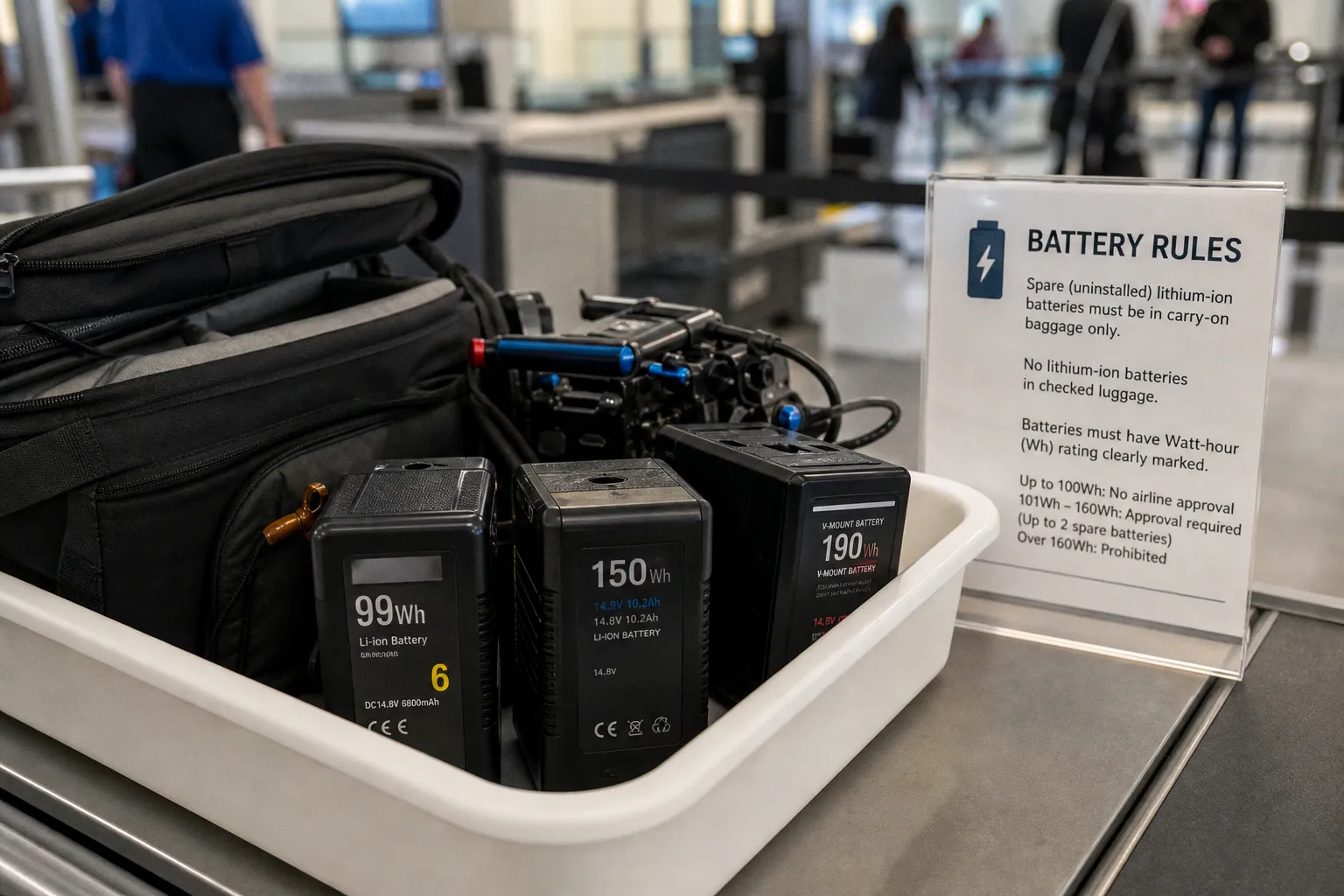
The cleanest line in the rulebook is 100Wh. Any lithium-ion battery rated at 100Wh or below travels in carry-on luggage with no paperwork, no airline notification, and no prior coordination, provided it is a personal device, an installed unit, or a spare. You walk through TSA the same way you walk through with a phone. That is the entire promise of the tier.
For working crews, this is the sweet spot of operational simplicity. A 95–98Wh micro-V-mount powers a small LED mat, an on-camera monitor, or a wireless video transmitter for hours on end. A 90Wh pack such as the Anton/Bauer Titon 90 sits comfortably under the line and gives you most of the runtime of a larger brick with none of the regulatory friction.
Three caveats, and they bite often:
- Installed versus spare changes the optics, not the rule. A battery mounted to a camera body rides the X-ray belt as part of the rig; no special handling. The same battery loose in your kit pouch invites an officer's discretion. Keep spares visible at the top of the bag.
- Quantity is uncapped at this tier. You can carry two, four, or six cells under 100Wh. The rulebook does not specify a limit, though individual airlines do.
- Airlines can override downward. Some international carriers tighten the sub-100Wh rules. I have watched a 92Wh pack get a closer look at Heathrow because of one carrier's policy. Always check the dangerous-goods page 72 hours before wheels-up.
Below 100Wh, your airport experience is a non-event. Above it, you are no longer luggage. You are cargo, and the paperwork begins.
The 101Wh–160Wh Band — Where Airline Approval Becomes Mandatory
The middle band is where the working world collides with the regulatory world. Any lithium-ion battery rated between 101Wh and 160Wh — which is the vast majority of full-size V-mounts you would actually want on a serious set — is permitted on passenger aircraft only with explicit airline approval, only in carry-on, and only as installed equipment or with a hard cap of two spare cells per passenger.
The two-spare ceiling is regulator arithmetic. The cumulative energy of two 160Wh cells is 320Wh, which sits at the upper bound of what a single passenger seat block can be reasonably expected to contain and isolate in a thermal event. Add a third cell at the top of the band and the risk curve tips. Halve the cell capacity and you can carry more spares, but for any pack above 100Wh, the practical ceiling to memorize is two.
This is the workflow I run with my own crew before any air-travel day:
1. Inventory every V-mount going into a bag. Photograph each label, top and bottom. Date-stamp the photos in the camera roll.
2. Identify every pack above 100Wh. Mark each with a strip of red gaff tape across the D-tap side. A visual flag prevents the wrong cell going into the wrong bag on a panicked load-out.
3. Contact the airline 72 hours before departure. Most carriers have a dangerous-goods desk, an email form, or an online form. Ask: "I will be carrying N spare lithium-ion batteries, each rated X Wh, in carry-on. Do you require any additional documentation or labelling?" Save the reply. Print it. Stick a copy in the lid of the case.
4. Configure the carry so the high-capacity spares are accessible at the top. One cell per clear pouch, label facing the clear side. The X-ray image needs to be unambiguous.
5. Confirm the return-leg rules on the same booking. Originating carrier policy does not always govern the return flight; domestic legs frequently apply the tighter standard.
The approval step is, in regulatory framing, what protects the flight. In producer framing, it is the difference between boarding and a long evening in a hotel lobby with no equipment, no shoot, and no recourse. Treat it as a deliverable, not a courtesy.
Above 160Wh — Hard Prohibition, Without Appeal
Above 160Wh, passenger-aircraft transport is closed. The line is not bureaucratic; it is thermodynamic. A 200Wh-plus cell contains enough stored energy that, in an internal short, the resulting thermal runaway can breach the casing, ignite adjacent cells, and propagate through a packed hold faster than a cabin crew can react. The 160Wh cap exists because it sits just below the threshold at which a single cell's worst-case failure cannot be reliably contained by a cargo-bay suppression geometry.
The bright line is firm:
- Cannot be carried on.
- Cannot be checked.
- Cannot be shipped as passenger baggage.
- The airline cannot grant an exception, because the rule is regulator-issued, not airline-issued.
So what do you do when your lighting package genuinely needs more than 160Wh per pack? Three workable paths exist.
- Run smaller packs in parallel. Two 150Wh bricks driving the same light head through a hot-swap or Y-cable deliver 300Wh of runtime with zero regulatory exposure above 160Wh. The wiring is fiddly; the math is easy.
- Ship ahead as manifested dangerous goods via freight. Specialized carriers — film-experienced 3PLs in particular — can move high-capacity cells as declared hazmat. Paperwork-heavy, expensive, slow. Also the only legal path.
- Rent at the destination. In most major production hubs, a rental house will deliver charged V-mounts to your hotel or set the morning of. The cost is a fraction of a hazmat surcharge and you skip the airline entirely.
Do not, under any circumstance, attempt to fly a battery above 160Wh in checked luggage on the hope it will not be flagged. It will be flagged. It will be confiscated. Depending on the jurisdiction, civil penalties will follow.
Above 160Wh, the conversation with the TSA officer is not a conversation. It is a surrender.
Packing Protocols — X-Ray Legibility Decides Whether the Bag Moves
A perfectly compliant battery can still be non-compliant in the wrong bag. The X-ray image an officer sees tells a story. If the story is "unidentifiable rectangular objects tangled in cables," the bag pulls to the side, every cell gets inspected, and the line grows.
| Packing decision | What works | What gets you pulled |
|---|---|---|
| Installed battery on camera or light head | Mounted and visible, D-tap out, label readable | Buried in a case pocket with cables coiled over the top |
| Spare battery pouches | Clear-top zip pouches, one cell per pouch, label facing clear side | Cloth battery bags, opaque rolls, multiple stacked cells |
| Cable routing | Velcro-anchored, laid flat, signal and power separated | Coiled power and signal together — the unreadable "blob" X-ray signature |
| Label protection | Over-laminated Wh sticker; or factory label under a clear heat-shrink sleeve | Worn-through label, hand-written tape, marker over the original print |
| Documentation carrier | Printed airline approval letter taped to the interior lid of the case | Loose printouts buried in the main gear pocket |
Three secondary points worth absorbing before you pack.
Heat is not your friend. Cargo holds swing from −40°C on the ramp to +40°C on the tarmac. Insulated pouches help, but the bigger lever is keeping your spares in the cabin, where climate control and human attention exist. That is also why regulators require carry-on for spares — fire suppression, communication, and oversight are in the cabin, not the hold.
Battery age and Wh drift matter. Older cells lose capacity, but the printed Wh label is what the regulator sees. If a re-wrap has been applied with both old and new figures, both are printed, the officer cannot tell which is current. Carry only the casing-labeled figure in your verbal answer, and photograph the casing label close enough to read.
State-of-charge for travel. IATA guidance recommends spare lithium-ion cells carried at no more than 30% state-of-charge. Most airlines do not enforce this at the gate, but a partial charge is the safest configuration for transport in general and your best footing if the rule ever gets cited.
When budgeting a season's worth of V-mounts, vendor pricing for the same Wh class can swing noticeably. Cross-referencing a few trusted suppliers before committing to a purchase or a long-term rental agreement is just good practice.
The Pre-Flight Battery Checklist
Before I close any case heading to an airport, the list I run through is short and unforgiving:
1. Wh ratings inventoried and photographed, top and bottom of every label.
2. Red gaff tape on every battery above 100Wh, visible to crew and officer alike.
3. Airline approval letter printed and bagged inside the lid, confirmed within 72 hours of departure.
4. Spare-cell count verified — two maximum in the 101–160Wh bracket, with sub-100Wh caps confirmed per carrier.
5. Each spare in its own clear pouch, label facing the clear side.
6. Cables velcroed and routed, power and signal separated.
7. State-of-charge at or below 30% for spares.
8. Cash backup plan. Know in advance whether the destination rental market is open, what it costs, and how fast it can deliver. If the worst happens and a pack gets pulled, an hour of advance research saves a full day of waiting.
If even one of these steps is in question, the bag does not get closed. Unpack, fix the gap, repack, check again.
A Final Word From the Sound Desk
I spend my working life listening — to the noise floor of a film mix, to the transients of a foley performance, to the phase relationship between an actor's vocal and the room tone underneath it. I do not treat the kit that powers my work as an afterthought, because nothing that loses a day's worth of capacity to a clipped lithium cell — or worse, never makes it to the stage because it sat in a TSA locker — has done its job.
The watt-hour rating on a V-mount is the most consequential figure on the entire label. More important than brand. More important than max discharge. More important than any marketing claim about airline-safe packaging. Read it, photograph it, and refuse to fly with any battery that does not match your reading and your airline's stated policy. Five specs, one printed number, one habit — that is the difference between a working kit and a stranded shoot.