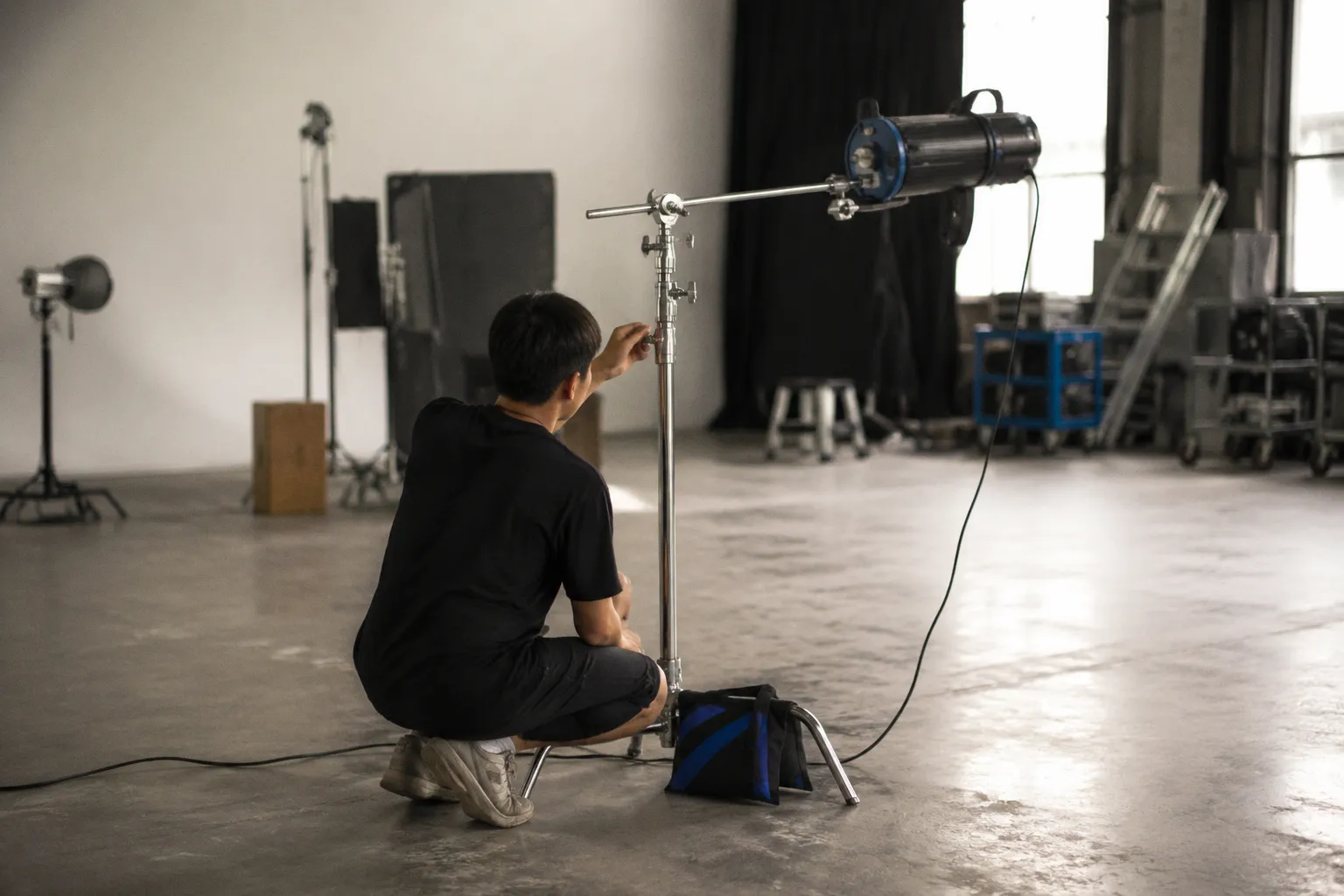
Every grip who's logged real hours on a busy set has seen this exact moment. A C-stand looks rock-solid during pre-rig. The fixture is balanced, the modifier is locked, the arm is fully extended.
This is the single most common equipment failure on a lighting set, and the fix is mechanical, not magical. There is a reason professional grips swear by a handful of physical rules that have nothing to do with brand loyalty, fixture wattage, or which LED panel the rental house is pushing this quarter. When you understand why the slip actually happens, you stop chasing the symptom and correct the cause in under thirty seconds.
The Physics of the Right-Hand Rule
Let's break down what a grip head is actually doing when it's holding a load. The head is not just a clamp. It is a directional clutch. Inside that familiar two-knob assembly, there's a threaded shaft and a pair of machined friction plates. The way the entire clutch assembly is threaded means that rotational force from one direction tightens the moving parts against each other, while rotation from the other direction opens them up. Hang a heavy fixture on the wrong side of the column, and gravity becomes your enemy. Hang it on the right side, and gravity becomes your silent rigger.
That distinction is what the industry calls the righty-tighty rule — and it's not folk wisdom. It's a direct consequence of how the grip head's threading is cut. When you tighten the knob clockwise, the friction plates compress and resist the load. When the load itself generates a clockwise rotation at the clutch, you get the same compressive effect — for free, perpetually, without anyone touching the knob.
If the grip head sits on the right side of the stand, the weight of the load naturally tightens the clutch.
Here is how we apply it on a working set. Stand facing the C-stand, with the base between you and the fixture. Look at where the arm extends. The grip head — the chunky metal hub holding your light, boom, or flag — should be on the right side of the stand's vertical column as you face the load. When the fixture's weight pulls down on the arm, that downward force creates rotational torque that pushes the grip head's internal mechanism in the tightening direction, not the loosening one. Reverse the orientation, and every Newton of fixture weight is working to unscrew the head off the stand.
Quick Visual Reference for the Load
We use a simple mental clock-face trick to teach new grips. Imagine a clock face on your grip head, with the tightening direction at 12 o'clock:
| Stand Configuration | Fixture Side | Grip Head Position | Result |
|---|---|---|---|
| Correct rig | Right (3 o'clock) | Left of load | Weight tightens the clutch |
| Incorrect rig | Left (9 o'clock) | Right of load | Weight loosens the clutch |
| Boom setup | Arm centered | Behind the column | Torque stays balanced |
Once you've trained your eye to spot the right-side orientation, you'll start seeing the wrong setups everywhere — on music video sets, indie features, talk shows, and corporate shoots. The single fastest way to correct your grip head setup is to walk up to the stand, identify where the load is hanging, and rotate the head 180° if it's sitting on the wrong side of the column. The whole correction takes longer to read than to do.
A quick note on the column itself: C-stand risers come in two styles — the traditional sliding riser and the newer spring-loaded variety. The righty-tighty rule applies to both, but the spring-loaded columns add a wrinkle. If the spring tension is too low, the column can slip even when the grip head is correctly oriented, because the riser's own locking mechanism is fighting gravity independently of the head. Always test the column lock before you worry about the head. Grip head orientation and riser lock are two separate systems, and both have to be right.
Gravity as Your Assistant: Aligning the Load to Tighten the Clutch
The righty-tighty rule is the foundation, but the next step is teaching gravity to do the work for you. Most C-stand failures we see on set aren't dramatic collapses. They are slow drifts — the kind that ruin focus pulls, shift the bounce angle mid-scene, or quietly snap a tungsten bulb filament as the fixture settles onto a cooler surface.
When a fixture drifts, the grip head is the culprit in roughly 80% of cases. The other 20% is base instability, which we'll get to. So we always start the diagnostic at the top.
A proper orientation looks like this: the arm extends out from the column, the grip head sits at the end of the arm, and the fixture or boom hangs from the head. The fixture's center of gravity should pull directly down through the grip head's clutch axis, not off to one side. If the light is hung at a sharp angle because someone cranked the arm too far out, the head has to fight both the weight and the rotational leverage, which accelerates wear on the clutch and gives you a drift problem even when the head is technically tightened correctly.
The common mistake here is arm angle. A fully extended arm at 45° or more puts enormous lateral stress on the clutch because the load vector isn't straight down anymore — it's pulling diagonally, and that diagonal component generates a rotational moment that the clutch has to resist. Drop the arm angle to 20° or below and the load vector straightens out. Suddenly the clutch is only fighting gravity, which is exactly what it was designed to do.
The One-Hand Sanity Check
We use a simple physical test on every rig before we walk away:
1. Look at the column from the fixture side. Is the grip head on the right?
2. Trace an imaginary plumb line from the fixture down to the base. Does it pass through the center of the column?
3. Let go of the fixture for a half-second with one hand underneath. Does the head stay locked, or do you feel micro-movement?
If you feel micro-movement, the clutch is already under stress. Don't trust it. Loosen the head, reposition, and try again. The few seconds you spend here will save you a re-shoot and possibly a lot more.
Optimizing the Base: Aligning the Largest Leg with Your Payload
Once the head is correctly oriented, we work our way down to the base. A C-stand's three-leg base is a tripod, and like any tripod, it has a weak side. The longest leg — the one with the turtle base notch and the heavier casting — should sit directly under the heaviest part of the load. This is not optional. This is geometry.
When you hang a 2K Fresnel with a Chimera softbox on the end of an extended arm, the center of gravity shifts dramatically toward the load. If the longest leg is pointing away from the load, you are effectively standing the C-stand on a stool and asking it to balance a refrigerator. The longer leg gives you a wider footprint on the side that needs it, and it gives the shorter legs room to splay outward on the opposite side for counterbalance.
Here's the reasoning behind it: the longest leg has the highest moment arm — the distance from the column to the leg tip is greater than the other two. That extra reach translates directly into a wider support base on the load side. In physics terms, you're increasing the restoring torque that resists tipping. A C-stand with the longest leg under the load can tolerate a significantly higher off-axis force before it tips than the same stand with the shortest leg in that position. We're talking about the difference between a stand that survives a door slam and one that doesn't.
A practical way to confirm: after the rig is built, gently push the column with one finger at chest height. If the base tips or rocks, the leg orientation is wrong. A properly configured C-stand should resist that push like a tripod holding a cinema camera — solid, planted, no wobble.
Turtle Base vs. Detachable Base
If your C-stand uses a detachable turtle base, the longest leg is usually marked or obvious — it's the one with the receiver socket and the thicker crossbar casting. But on some older stands, the legs are uniform length and the only way to identify the longest one is to measure. We carry a Sharpie and mark the longest leg with a stripe on every stand in the grip package before we even hit the set. That way, when a PA grabs a stand off the cart, there's no guesswork about which leg goes under the load.
Beyond the Grip Head: Essential Counterweight Protocols
Even with perfect orientation, gravity is still gravity. That's why we use sandbags. A 15 to 20 lb sandbag (around 7 to 9 kg) draped across the shortest leg, opposite the load, is the industry standard for most standard lighting setups. We're not talking about delicate china up there — a C-stand with a 1K light, a softbox, and an arm fully extended can put serious leverage on the base, and a small bump from a crew member walking by can turn a stable rig into a falling one in a heartbeat.
But here's the trap: a sandbag is a mitigation tool, not a guarantee. We've seen setups with two sandbags still tip because the legs were misaligned. We've also seen bags draped over the wrong leg — typically the one closest to the load — which adds weight to the side that's already bearing the most force. That's like adding weight to the heavy side of a seesaw and expecting balance.
The logic is straightforward. The load is pulling the stand toward one direction. You need to counterbalance that pull by adding mass on the opposite side, as far from the column as possible, to maximize the counter-torque. The shortest leg, on the opposite side from the load, is the correct position because it puts the bag's weight at the widest available point on the counterbalance side — not because the leg is short, but because that's where the opposing moment arm is greatest.
Our Three-Rule Sandbag Protocol
- One bag minimum, properly placed. Shortest leg, opposite side of the load.
- Bigger light = bigger bag. A 2K or larger source with a heavy modifier warrants 25 lbs or more, and possibly a second bag if the arm is fully extended.
- Bag on the bar, not the leg tip. Drape the bag so it sits flat on the horizontal crossbar of the base, not hanging off the end of a leg where it can swing.
If you're working on polished wood, slick concrete, or any smooth surface, add a piece of rug grip or gaffer tape under the leg tips. C-stand legs on slick surfaces are a separate failure mode that sandbags alone won't solve — the legs will simply slide out from under the rig.
There's one more counterweight trick worth knowing. On long booms — the kind you see in interview setups where the light is 6 feet out from the column — a base sandbag isn't enough. You need a counterweight on the opposite end of the arm, attached to the head closest to the column. A 5 lb shot bag or even a water bottle clamped to the arm works in a pinch. The physics is identical to a seesaw: the farther out the load sits, the heavier the counterweight needs to be on the other side, and the closer to the column that counterweight is, the more of it you need. We carry three 5 lb shot bags on every job specifically for boom work, and they get used more often than most people realize.
Identifying Mechanical Fatigue in Aging Grip Equipment
The righty-tighty rule and proper leg alignment solve 90% of the slippage issues we see on set. The other 10% comes down to equipment that's simply worn out. Grip heads are mechanical devices, and like any mechanical device, the clutch surfaces wear down over time. A head that's been dropped, over-tightened with pliers, or used in salt-air environments will eventually lose the friction needed to hold a load — regardless of how perfectly you orient it.
The warning signs are easy to spot once you know what to look for:
- The fixture slowly drifts down even with the right orientation. The clutch is glazed or worn smooth.
- The head spins freely with very little resistance. Internal springs or washers have failed.
- Visible play in the head when locked. A quarter-inch of wobble means the clutch surfaces aren't making full contact.
- The handle feels gritty or skips. Threads are damaged, often from over-tightening with channel locks.
We tag and pull any grip head that shows these signs. There's no field fix for a worn clutch — no amount of grip tape, plumber's tape, or creative tightening will turn a dead head into a reliable one. If you're renting gear, inspect the heads on intake. If you own the gear, build a rotation schedule and retire heads the moment they start drifting. A 40-rig used grip head is not the same tool as a new one, and treating them as interchangeable is how people get hurt.
A grip head is a safety device, not a souvenir. Treat it like a car brake — if it doesn't hold, it doesn't leave the truck.
How to Test a Grip Head on the Bench
If you're doing a pre-season inspection on your own grip package, here's how we bench-test every head. Lock the head onto a column with no load. Tighten the knob firmly — hand-tight, not wrench-tight. Then attach a 10 lb weight to the arm at a standard extension and watch for 60 seconds. If the arm drops even a quarter-inch, that head gets tagged. We then spin the knob through its full range of motion a dozen times to check for thread smoothness. Any catch, skip, or gritty feel means the threads are damaged. Finally, we check the knob for play — rock it side to side while it's locked. If there's more than a millimeter of movement, the washers are compressed and the clutch isn't making full surface contact. Three tests, about two minutes per head, and you know exactly which heads are safe and which ones aren't.
The Pre-Load Checklist: A 30-Second Audit
Before you walk away from any C-stand rig, run through this list. We use it on every job, regardless of how simple the setup looks. A two-minute check at the start of a setup is worth a two-hour re-shoot at the end of the day.
- ☐ Grip head is on the right side of the column when facing the load.
- ☐ Longest leg is under the heaviest part of the load.
- ☐ Sandbag (15–20 lbs minimum) is on the shortest leg, opposite the load.
- ☐ Arm is locked and oriented to tighten, not loosen, under fixture weight.
- ☐ Fixture plumbs down through the column axis, not off-axis.
- ☐ Push test passes — no rock, no wobble, no drift with light hand pressure.
- ☐ Grip head clutch is clean, no glazing, handle tightens smoothly.
If any of those boxes is unchecked, don't call "ready." Fix it first. Most C-stand failures aren't surprises — they're the predictable result of someone skipping this list in a hurry.
Closing the Loop: Why the Simple Stuff Matters Most
We spend a lot of time in this industry obsessing over the newest LED panels, the fastest lenses, the most efficient codecs, the most aggressive autofocus systems. But the gear that actually keeps your set safe is the gear that was engineered in the 1970s and refined by decades of grip department war stories. A C-stand is a solved problem. The solution is a few rules of physics, applied consistently, by a crew that knows what to look for.
If you've been chasing mysterious drift, sagging softboxes, or that one stubborn C-stand on set that never seems to hold — don't blame the brand. Don't blame the wattage. Don't blame the rental house. Walk over, check the grip head orientation, confirm the longest leg is under the load, and put a sandbag on the right leg. In almost every case, that sequence is the whole answer.
We don't get to "fix it in post" when a 2K Fresnel lands on a talent's foot. The fix happens here, in the pre-rig, with a thirty-second audit and a few rules your hands and arms already know how to follow. Master the righty-tighty rule, and you master the C-stand.