A decibel meter doesn't lie. That low, pervasive hum bleeding into your pristine dialogue track—the one you spend hours in post trying to notch out—it often starts not with your audio gear, but with…
The Silent Partnership: Why Your Light Stand's Stability Begins with Power
A decibel meter doesn't lie. That low, pervasive hum bleeding into your pristine dialogue track—the one you spend hours in post trying to notch out—it often starts not with your audio gear, but with a poorly secured lighting instrument vibrating on a marginally stable stand. The hunt for a silent set is a holistic one, and it extends to the very electrons feeding your lamps. The solution to a clean power source and a rock-solid stand converges in one elegant, underutilized piece of rigging: marrying your V-mount battery to the stand itself with a super clamp.
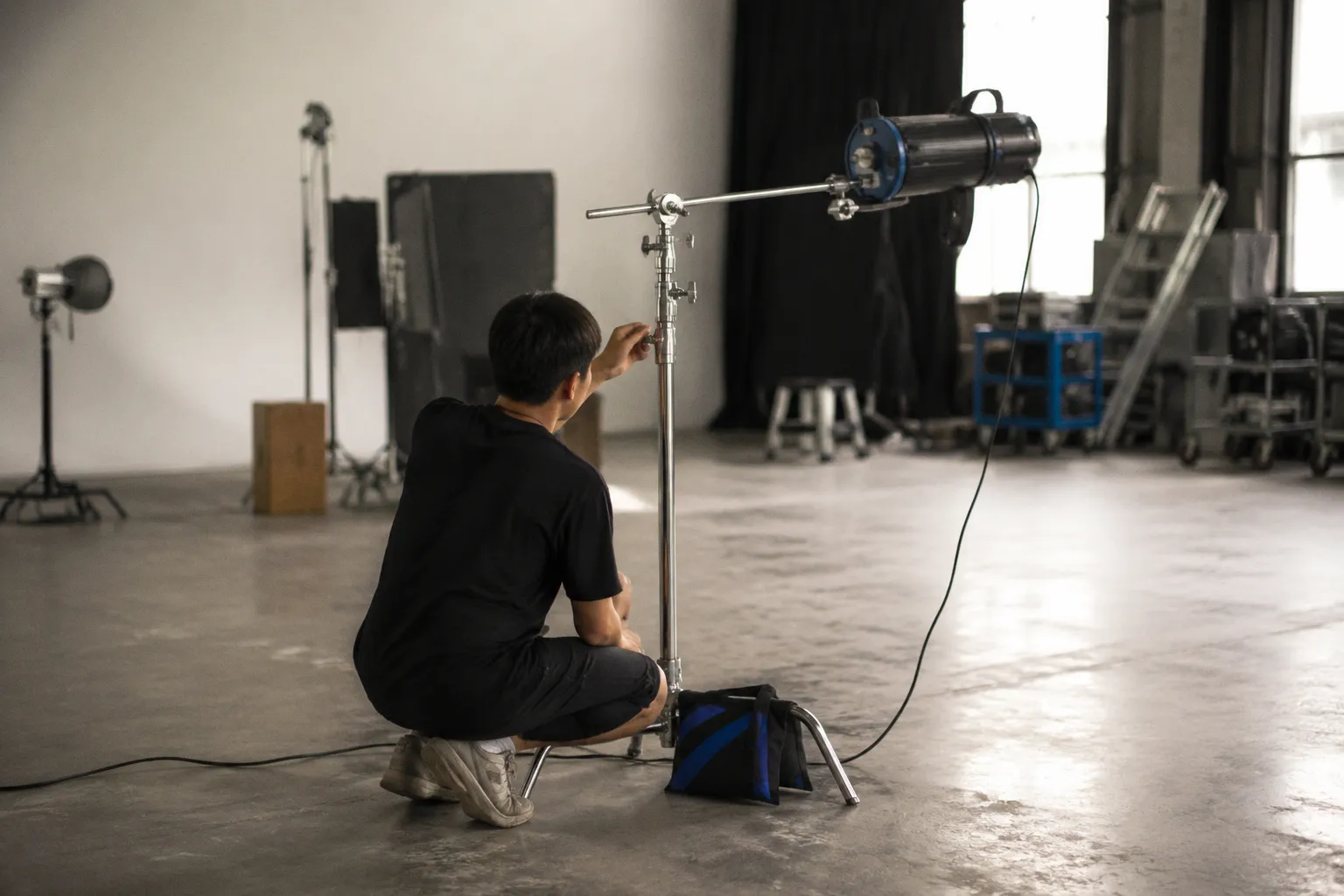
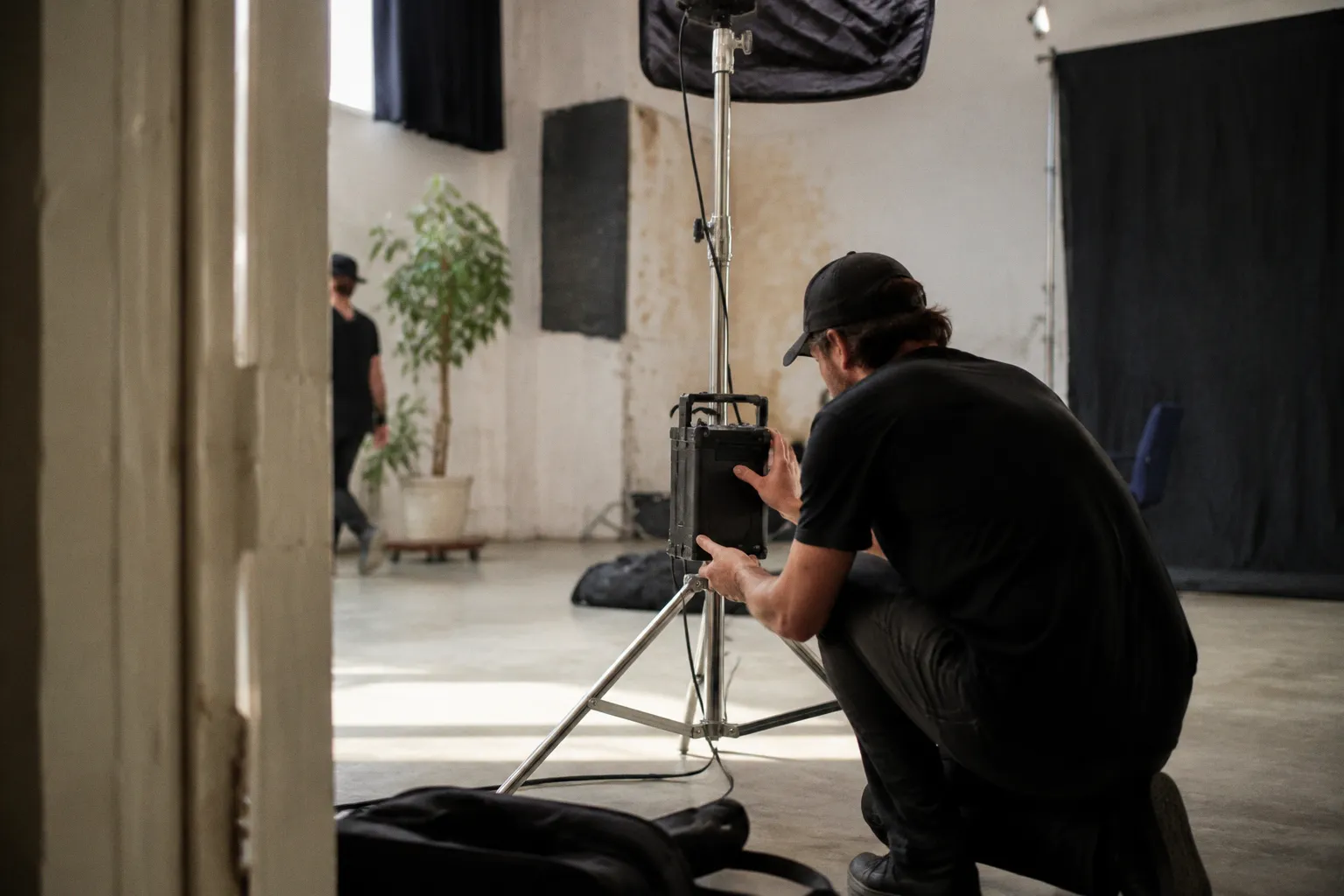
This isn't just a cable-management hack. It's a fundamental realignment of your rig's center of mass, transforming a heavy battery from a dangling liability on a light's yoke into a stabilizing force integrated into the stand's own structure. You're not just powering a light; you're engineering a more coherent, vibration-resistant system.
Hardware Synergy Between V-Lock Plates and Super Clamps
Forget the notion of a battery plate as a simple, passive bracket. When fused with a super clamp, it becomes an active component in a load-bearing system. The magic is in the interface—a convergence of two standardized, yet profoundly robust, mechanical languages.
The super clamp is the universal translator. Its jaws, capable of gripping anything from a 13mm slender riser to a beefy 55mm C-stand post, provide a foundational anchor point. Its 1/4"-20 and 3/8"-16 threaded stud is the handshake that accepts a thousand different accessories. This is where the V-lock plate enters the conversation.
Dedicated plates, like the SmallRig 2989, are machined with those same industry-standard threads countersunk into their flat backs. You're not forcing a proprietary connection; you're using a dialect of rigging that every grip and gaffer understands intuitively. The marriage is straightforward: thread the plate onto the clamp's stud, tighten the set screw, and you've created a new, integrated mounting point. The system's strength is derived from this simplicity—the load path is direct, metal to metal, without fiddly adapters introducing potential failure points.
Mechanical Limits and Clamping Ranges for Studio Risers
Your battery becomes a silent sandbag, its mass working *with* gravity, not against it, turning potential energy into unshakeable stability.
The physics here are beautifully uncomplicated, but the parameters are non-negotiable. A standard Manfrotto 035 super clamp is rated for a 15kg (33.1 lb) payload. Your heaviest 290Wh V-mount battery, at around 1.6kg, uses a mere fraction of that capacity. This margin isn't for show; it's your safety buffer against shock loads—a cable yank, an accidental bump—without a moment's thought of overloading the mechanism.
The critical variable is the clamp's range. That 13mm to 55mm specification means you must match the clamp to the stand's diameter at your desired mounting point. Clamping onto a thin, single-riser light stand's upper column is a different proposition than securing it to the thick, knurled lower riser of a combo stand. The former offers minimal surface area and risks crushing the tube if overtightened, especially on carbon fiber models where the material can crack under focused pressure. The latter provides a massive, stable contact patch. Always choose the point that maximizes metal-to-metal contact over the stand's structural tubing.
Cable Routing and Voltage Management via D-Tap Interfaces
Here is where we must address the silent killer of clean power: voltage sag and inductive interference. A V-mount battery outputs a nominal 14.8V. It's a raw, unregulated DC signal. Your light fixture, whether it's a COB or an LED panel, expects a clean, stable supply. The journey between them is where noise is born.
The cable is the weakest link, and its routing is your first line of defense. You're not just tucking wires away; you're managing an electromagnetic field. A coiled D-Tap cable running alongside AC mains lines will act as an antenna, coupling with 60Hz hum. Run it separately. Keep it tight to the stand's legs using velcro straps, creating a direct, short path from battery to light.
More critically, the D-Tap connector itself is a potential point of failure. It's a friction-fit connection, susceptible to vibration-induced loosening. On a dynamic set, where doors slam and crew moves, this can create intermittent power drops—micro-second interruptions that manifest as flicker or, worse, a hard reset of your light's settings. In a perfect world, you'd secure the D-Tap connector to the stand with a small clamp or tape, creating a strain relief that isolates the electrical connection from mechanical stress.
Strategic Battery Placement for Center of Gravity Optimization
This is the core acoustic principle applied to physics: managing resonance through mass distribution. A top-heavy stand is like an unstable microphone stand—it will translate every footstep into a visible wobble. The goal is to lower the resonant frequency of the entire system below the threshold of on-set disturbances.
Mounting the V-mount battery low, on the stand's lowest leg or the lower riser section, does two things. First, it dramatically lowers the center of gravity, making the stand profoundly harder to tip. Second, and this is the key insight, it changes the stand's vibration profile. The added mass at the base dampens high-frequency vibrations—like the buzz from an HVAC vent or the low-frequency rumble from a nearby roadway—preventing them from traveling up the stand and modulating the light output. You're adding tuned mass damping, absorbing kinetic energy before it becomes a problem.
Power Limitations and Surface Protection for Professional Rigging
The final, sobering reality check: this method is for powering moderate-draw fixtures. A single V-mount battery plate is a point-source solution. It will happily feed a 100W or even a 200W LED panel or COB light for a respectable run time. Attempt to pull 600W or more from it, and you're asking for trouble—rapid voltage drop, overheating, and a potential fire hazard. For high-draw instruments, you need dual-battery plates with proper parallel circuitry or a direct AC mains connection.
There's also a tactile respect for the gear we must observe. The jaws of a super clamp, when torqued, can mar the anodized finish of a stand. For rental house gear or pristine equipment, a simple solution is to use a strip of gaffer tape or a thin piece of leather as a protective buffer between the clamp's jaws and the stand's tubing. It's a small gesture that preserves the quiet professionalism of the tools.
The pursuit of a silent set is a conspiracy of details—a power cable routed with the same care as a boom pole, a battery placed with the deliberation of a microphone.
In the end, this rig is a metaphor for good sound design itself. It's about intentional coupling and strategic isolation. You're creating a direct, stable electrical path for power while mechanically isolating the light from environmental vibration. The result is a dual stability: your stand won't tip, and your light's output remains flicker-free, its power source silent and integrated. You're not just building a power solution; you're constructing a platform for flawless illumination, where the only thing you hear is the dialogue you're there to capture.