New Megadap ETZ 21 Cine Adapter Announced
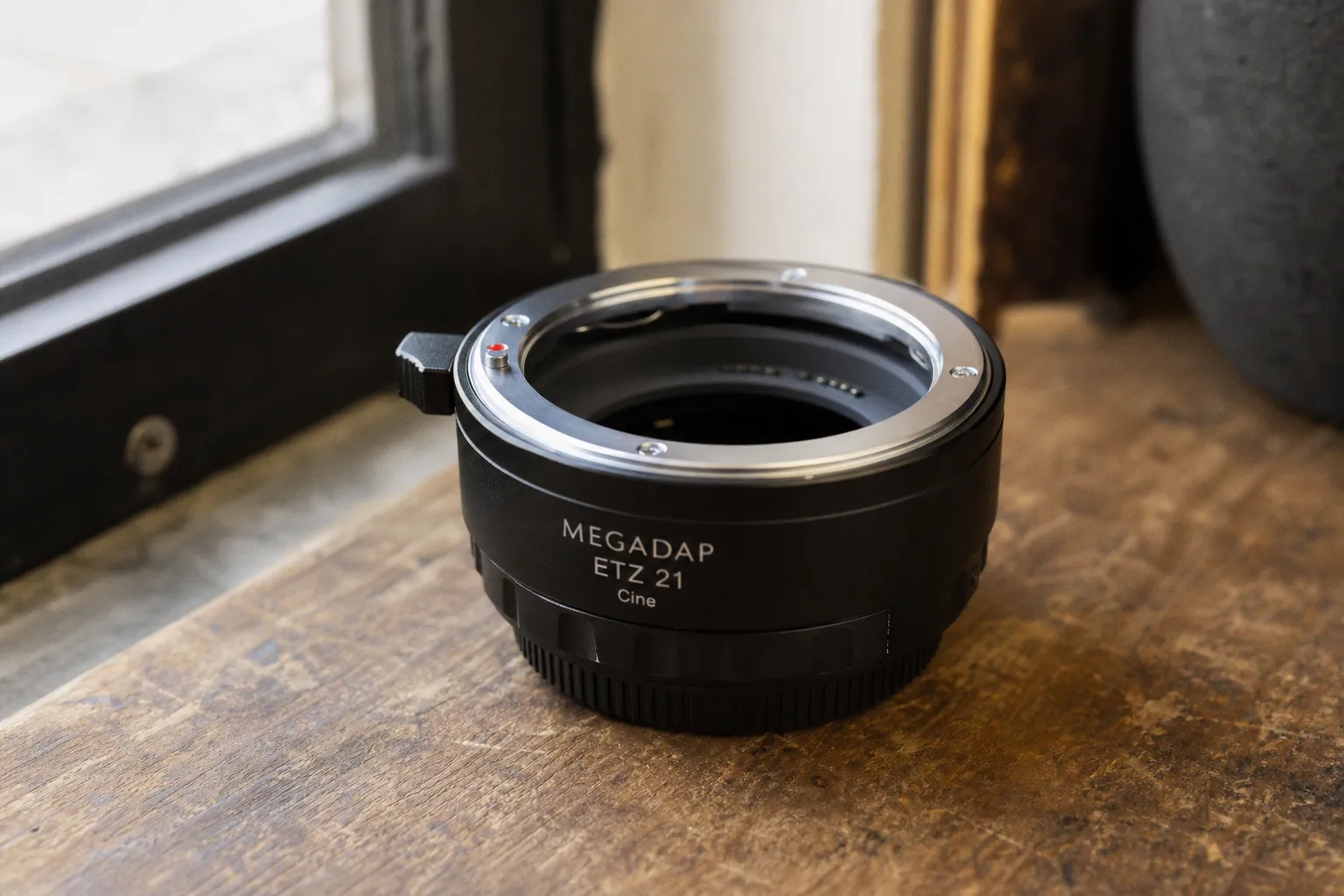
Megadap has announced the ETZ 21 Cine adapter, a cinema-oriented revision of its existing Sony E-to-Nikon Z mount converter. Per Nikon Rumors, the new unit adds enhanced structural support for heavier cinema lenses and a locking mechanism.
What the announcement specifies
Two hardware deltas versus the standard ETZ21 are listed:
- A housing reinforcement targeting heavier cine glass — relevant to PL-housed primes, large cine zooms, and stills primes retrofitted with cine housings.
- A locking interface at the lens-mount junction.
No flange-distance tolerance, load rating, material spec, or cycle rating has been disclosed alongside either feature. The release framing is binary ("enhanced," "secure") without tolerance numbers attached. That is the standard pattern for early product announcements, and it is the reason pre-shipment bench data matters here.
Failure modes the Cine variant targets
Two real failure modes in adapter-driven cine workflows are addressed by the announced changes:
- Lateral image shift under heavy glass. Adapter housings without reinforcement show measurable axial and lateral movement when paired with cine primes above ~1.5 kg. Without published deviation figures, bench data on shift remains the only objective check on the housing claim.
- Focus drift from rig vibration. Gimbal motors, vibration isolators, and stabilizer rigs induce micro-shift at the lens-mount interface. A positive lock removes that drift vector if locking geometry is repeatable across cycles.
Both failure modes are documented in field reports from hybrid Z-mount operators running E-mount cine glass via adapters. The Megadap release addresses them with plausible hardware interventions — without measured numbers.
What's not in the release
Unaddressed by the announcement:
- Electronic pass-through behavior. Aperture response timing, EXIF handshakes, and pin-by-pin contact behavior on the Cine version are unspecified.
- Stabilization coupling. Any combined-IS performance change introduced by adapter electrical latency is unspecified. On cine primes lacking electronic contacts, this point is moot; on stabilized stills glass run via adapter, it is not.
- Optical path. Whether the Cine version retains the all-mechanical, no-glass construction of the standard ETZ21 — or introduces additional optical elements to accommodate the locking mechanism — is not stated.
Pre-deployment verification
Field users should resolve three points before mounting a paying client behind the adapter:
1. Flange-distance deviation across Z body generations, measured against a collimated test target at infinity.
2. Lock cycle repeatability — minimum 200 mount/dismount cycles, checked for developed play at the locking interface.
3. Axial shift under a representative cine prime at the working focal length, lateral load applied.
Manufacturer framing here is broad-tolerance language. The announcement is a hardware-iteration marker, not a verified datasheet.
Verdict
Hold for independent bench data. The two announced interventions — housing reinforcement and a locking interface — match real failure modes in cine adapter workflows, and Megadap's standard ETZ21 is a known quantity on the platform. Without published tolerances and third-party shift measurements, "enhanced structural support" remains a marketing phrase. Buy signal: not yet.