Robotic Broadcast Cameras Market : Global Industry Analysis and Opportunity Assessment, 2036
A 9.8% CAGR is the useful number here. Future Market Insights says the robotic broadcast cameras market is projected at USD 1,860.7 million in 2026 and USD 4,739.1 million by 2036.
The market pitch is really a control-room pitch
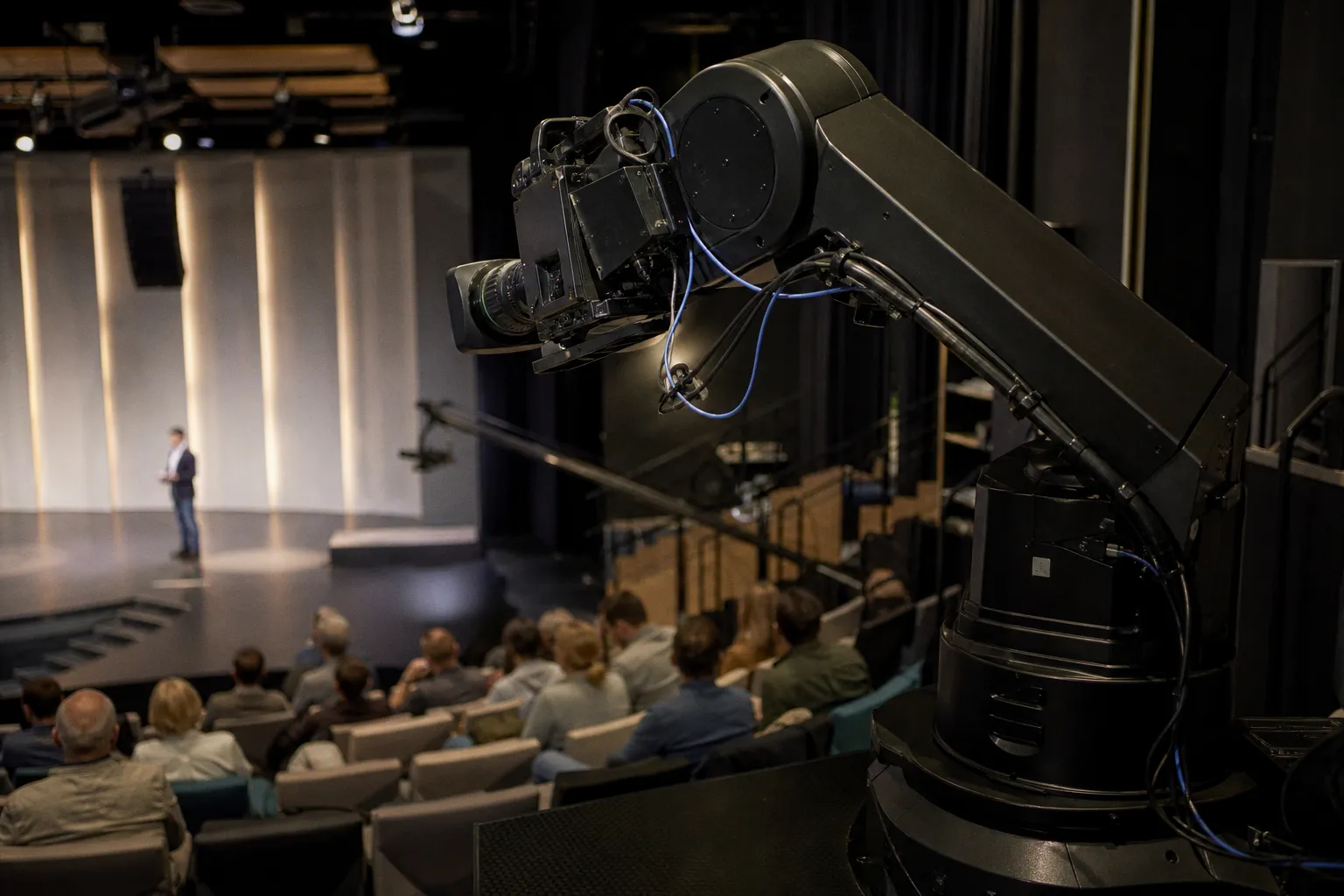
The report frames robotic broadcast cameras by camera type, application, resolution, control type, sales channel, and region. That matters because “robotic camera” is not one device class.
The listed camera types include:
- PTZ robotic cameras
- studio robotic cameras
- rail or track cameras
- AI-assisted robotic cameras
Applications include live sports, studios, newsrooms, events, and houses of worship. Resolution bands include HD, 4K, 8K or high-frame-rate formats, plus other formats. Control types include remote operator control, automated tracking, and hybrid control.
The practical read: buyers should not start with sensor size or brochure resolution. Start with control tolerance. Can the system repeat framing? Can presets survive a live show? Does the controller fit the routing and operator layout before the install starts?
Future Market Insights quotes Anurag Sharma, its principal analyst, saying adoption is often influenced by whether the control setup fits the production environment before installation begins. That is the correct failure point to watch. A PTZ that resolves enough line pairs but cannot recall a useful shot under pressure is still a bad camera position.
Canon and Panasonic are aiming at the same bottleneck
The report cites two recent product moves.
Canon introduced the CR-N400 and CR-N350 in November 2025 for broadcast, corporate, education, and live-event production. The models are described as offering 4K UHD at 60 fps and 40x Advanced Zoom in Full HD. The stated use case is fixed shots and recurring room setups without adding more floor operators.
Panasonic introduced the AW-RP200 remote camera controller in September 2025 with macro functionality for multi-camera operations. The report positions that control layer as a way for buyers to check shot recall and IP routing before committing capital to a studio or venue refresh.
That split is instructive. The camera head gets the spec-sheet attention: 4K UHD, 60 fps, zoom range. The controller decides whether the system behaves like a production tool or a collection of motorized heads. Macro behavior, routing, and recall are not cosmetic features. They are the difference between one operator managing useful coverage and one operator fighting latency, pan speed, and inconsistent framing.
For live sports, the report points to goal areas, benches, tunnels, and commentary zones. These are not beauty-shot locations. They are restricted or cramped positions where a manned camera may be unsafe or impractical. For studios, houses of worship, and event rooms, the logic is ceiling and wall placement: compact PTZ housings, repeatable angles, no camera platform.
What crews should verify before buying
The labor data in the report is broad but relevant: BLS projects 6,400 annual openings for film and video editors and camera operators from 2024 to 2034. The market narrative ties that pressure to systems that let one control room manage more repeatable angles across worship spaces and event rooms.
Do not treat that as proof that every room needs robotic cameras. Treat it as a test brief.
Before specifying a system, check:
- preset repeatability after power cycles and long operating days
- pan/tilt smoothness at live editorial speeds
- controller layout for multi-camera operation
- IP routing behavior in the real production network
- zoom usability at the required framing distance
- whether automated tracking is good enough for the room, or only a demo feature
- service path through direct OEM, integrator, rental, or managed model
The adjacent market noise around automotive sensors and camera technologies is less relevant for broadcast buyers, even if it points to broader investment in imaging, perception, and alignment systems. A venue camera is judged by different metrics: framing consistency, control latency, installation tolerance, and whether the operator can hit the shot twice.
Verdict: the 2036 growth forecast is plausible as a demand signal, not a purchase argument. Buy robotic broadcast cameras only where remote placement, repeatable movement, and control-room efficiency beat a staffed camera position. Otherwise, the automation adds failure modes without adding usable coverage.