Virtual Metalens Technology Makes For More Flexible Infrared Imaging
A Nottingham Trent University team has published a virtual metalens that replaces fixed nanostructure arrays with a spatial-light-modulator-driven thin-film pattern, retunable on the order of milliseconds.
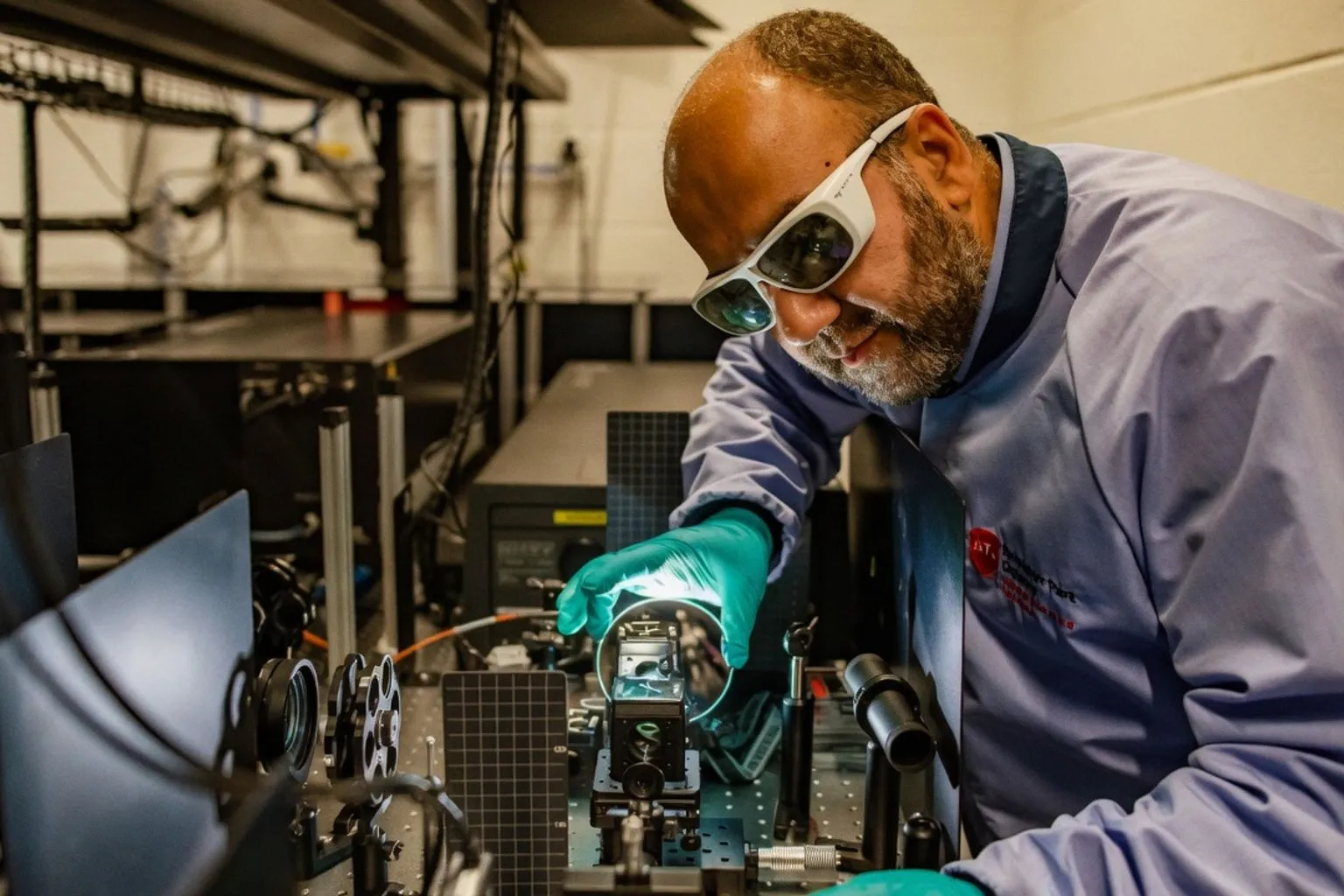
The Hardware Bottleneck
IR imaging has long depended on narrow-bandgap semiconductors, each sensitive only across a defined slice of the IR spectrum. Broadband coverage means stacked sensors, multiple cameras, or filter-wheel arrangements. Nonlinear metasurfaces — engineered nanomaterial arrays hundreds of times thinner than a human hair that replicate prisms, mirrors, and lenses in a flat format — have shown the ability to upconvert IR into visible bands readable by conventional silicon sensors. The catch: those nanostructures are fixed at fabrication. Focal length, dispersion profile, and beam geometry are locked in at the lithography step. External stimuli like applied voltage or temperature shifts can nudge performance, but the operating envelope stays narrow.
The Virtual Substitution
Rahmani's group drops the physical nanostructure entirely. A thin film serves as the medium, and a spatial light modulator writes the metasurface pattern onto it optically, pixel by pixel. Patterns can be swapped in roughly the time required to blink — milliseconds, not minutes. One device, multiple optical functions, sequenced in software rather than committed to glass. The published paper demonstrates one upconversion configuration. The architectural implication is that focal length, phase profile, and beam steering become runtime parameters rather than hardware commitments, set by the SLM drive signal rather than a fabrication run.
What To Verify
Three metrics will decide whether this leaves the bench. Diffraction efficiency at each SLM pixel versus a lithographic metalens: modulator phase step count and pixel pitch set the yield, and any gap shows up as stray light and contrast loss. Optical throughput at the thin-film interface — losses here compress dynamic range and elevate the noise floor, a direct hit to usable signal. Integration budget: SLMs carry volume, mass, and power draw, which erodes the miniaturization argument that made metalenses attractive for cameras in the first place. For cinematography-adjacent applications — full-spectrum capture, IR-assisted focus pulls, low-light sensor assist — the immediate read is that broadband IR no longer demands a purpose-built metasurface per spectral window. The open question is whether a virtual metalens can match the diffraction efficiency and stray-light tolerance of a fixed design, or whether reconfiguration buys flexibility at the cost of final image quality.