There's a particular hiss at 6.3 kHz that shows up only when a wireless lavalier transmitter gets within a meter of an active Wi-Fi router.
When a creator asks me about the best wireless lavalier microphone for their phone-based run-and-gun setup, they're really asking three questions at once. They want clean dialogue that survives post-production. They want a transmitter small enough to disappear under a collar or behind a button. And they want the rig to behave like a piece of consumer electronics — plug it in, forget it exists. That's a completely reasonable ask. The catch is that mobile production adds acoustic variables a studio never had to negotiate: congested RF space, unpredictable ambient noise, energy budgets that drain through a ten-hour shoot, and the unforgiving latency demands of smartphone encoders. Every gram on a transmitter, every decibel of self-noise, every millisecond of end-to-end delay gets exposed. Here's what actually separates a professional wireless lavalier system from a Bluetooth-toy disappointment in 2026.
The Role of 2.4GHz Digital Transmission in Mobile Environments
The wireless lavalier market pulled itself out of the legacy UHF mud around 2020 and committed, almost universally, to the 2.4GHz digital band. That move wasn't aesthetic — it was acoustic. The 2.4GHz band sits inside the same spectrum your Wi-Fi router, Bluetooth keyboard, and a dozen other consumer devices have already colonized. Living there cleanly requires dynamic frequency hopping, robust encryption, and tight digital compression happening inside the same window as a human lip flap. Get it right, and you can pull production-grade dialogue out of a transmitter the size of a postage stamp. Get it wrong, and the dialogue resolves to digital hash the moment the talent walks past an espresso machine.
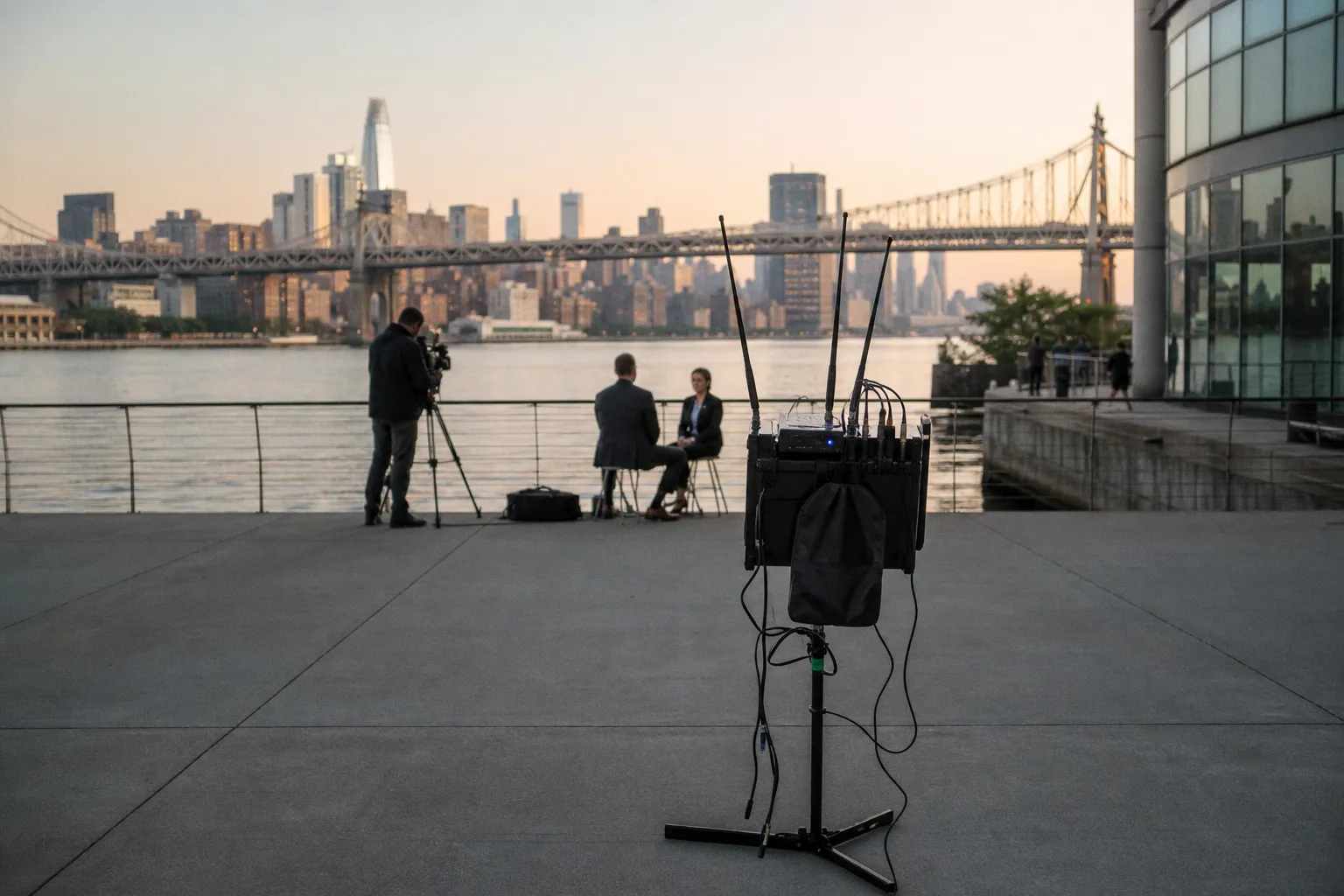
The RØDE Wireless PRO, for instance, advertises a 260-meter line-of-sight range using 2.4GHz digital frequency hopping. On a documentary shoot last spring, I had a subject walking back from a marina at roughly 180 meters — through a chain-link fence, past two parked delivery vans, and across a patch of wet asphalt — and the signal held without a dropout. The older fixed-UHF systems can't make the same promise. A passing police radio, a wireless intercom from a neighboring set, or a high-output baby monitor can pin them at exactly the wrong moment, and when it happens you discover it two hours later when a producer asks why the host's punchline is a wall of static.
There's a caveat I need to surface, because pretending it doesn't exist would be a disservice. 2.4GHz is not magically immune to interference. Press a smartphone up against the transmitter, drop the receiver into a bag full of lithium batteries, or shoot inside a building with a metallic ceiling and you'll watch the noise floor climb. The smart systems mitigate this through aggressive frequency hopping and onboard DSP; the cheap ones simply hope you don't notice. Don't buy the cheap ones.
Why 32-Bit Float Recording Is a Game Changer for Run-and-Gun Shoots
If I had to insist on a single specification for mobile work, it would be 32-bit float internal recording. The DJI Mic 2 bakes 32-bit float directly into each transmitter. The acoustic reason this matters is the part most reviews skip past.
A standard 24-bit recording gives you roughly 144 dB of usable dynamic range. That's plenty inside a controlled room where a sound operator is actively riding the gain. On a run-and-gun shoot, "controlled room" is a fiction. Your talent steps from a quiet hallway into a four-lane intersection, laughs into the capsule at a sliver under clipping, then whispers a punchline to the camera. With 24-bit fixed gain, at least one of those moments is gone forever. With 32-bit float, the dynamic range stretches past the noise floor of human hearing and beyond the threshold of acoustic pain — every transient the capsule catches is recoverable, whether your levels were right or wildly wrong.
I've mixed footage shot this way. The host surprised a colleague on set, shrieked, then dropped to a conspiratorial whisper. In post, I could pull the loud peak down with a clip-based gain ride, float the whisper back up with a slow automation pass, and the dialogue stayed continuous in the timeline. With a 24-bit system set conservatively, I would have pulled the headset off and asked the producer if we could restage the moment. 32-bit float changes that entire conversation.
The practical implication is simple. Internal recording acts as insurance. Even if the wireless transmission drops at the worst possible moment — inside a building lobby with reflective glass and a dozen active Bluetooth beacons — you've still captured the take locally at the transmitter, in a format forgiving enough to rescue in post. That redundancy is what separates a professional tool from a consumer one.
Latency and Sync: Keeping Dialogue on the Lips in Smartphone Pipelines
Lip-sync error is one of those defects the viewer's brain rejects before the conscious mind can name it. Tolerance sits somewhere between 40 and 80 milliseconds for casual viewing, but for professional mobile video production anything past about 20 milliseconds of drift between picture and audio starts to read as a badly dubbed foreign film. The 2.4GHz systems that dominate the mobile lavalier category in 2026 hold their end-to-end latency between 5 and 10 milliseconds — comfortably inside the safety margin, even after the additional processing delay imposed by a smartphone's encoder and editing app.
What that means acoustically is that by the time the dialogue hits the timeline, the consonants are landing on the visible face. Plosives do not smear. Sibilance does not lag. The shooter behind the camera doesn't have to live with that nagging sense that the lips and the words have gone on a coffee break.
Latency compounds, though. Add a Bluetooth monitoring pair to the chain, route the audio through a noisy software mixer, and a 5ms round-trip becomes 40ms in a hurry. So when you evaluate systems, pay attention to the receiver's output stage. A receiver that hands a clean digital signal to your phone via USB-C or Lightning keeps the through-path tight. A receiver that funnels analog audio through a 3.5mm jack into a dongle adds exactly the kind of round-trip delay your talent will feel before you do.
Environmental Noise Cancellation and DSP in Busy Locations
The microphone pinned to the talent's chest is rarely the microphone you'll actually hear in the final mix — not in the worst case. What you'll hear is the microphone on the chest, plus the coffee machine three meters behind them, plus the bus that just rolled past the window, plus the HVAC unit pulsing on a six-second cycle. Mobile shooters do not have the luxury of empty rooms. They shoot in cafés, on sidewalks, in co-working spaces, in cars, in hotel ballrooms. Environmental noise isn't an edge case in this work — it is the job.
Treat noise reduction as a gain stage, not a fix-after-the-fact. Cutting 12 dB of HVAC rumble from a signal that was barely above the noise floor is post-production cosplay. Cutting 1 dB at the transmitter is engineering.
This is where DSP — digital signal processing — has done some genuine acoustic heavy lifting. The Hollyland Lark Max, for example, leans on onboard DSP for environmental noise cancellation tuned specifically to isolate voice. Other systems use adaptive filters that sense the consistency of the surrounding noise and carve it away without chewing into the speech spectrum. The clever designs apply this at the transmitter side, before noise has a chance to ride the wireless hop.
I get pedantic about where the processing happens because the result in the timeline is wildly different. Noise reduction at the receiver keeps the wireless signal clean — useful. Noise reduction at the transmitter cleans the source file you keep on the SD card — far more important, because you cannot un-cut a noisy recording you've already accepted into your timeline. A system that handles it at both ends is gold; a system that handles it only at the receiver is, at best, half an answer.
One last note on the practice: every DSP-cleaned signal degrades a touch in transient response. The leading edge of a /t/ or a /k/, the percussive snap of a properly enunciated consonant, gets rounded. In a dialogue-heavy documentary that's invisible. In a perfumery voiceover with the talent enunciating each consonant for camera, you'll absolutely hear the difference. Match the system to the deliverable, not the trend.
Power Management and Reliability for All-Day Field Production
Nobody schedules a ten-hour shooting day and then asks, at hour three, when the lavalier transmitter is going to die. The answer is unfortunately always. The question is whether the system was engineered to absorb that reality or to surprise you with it.
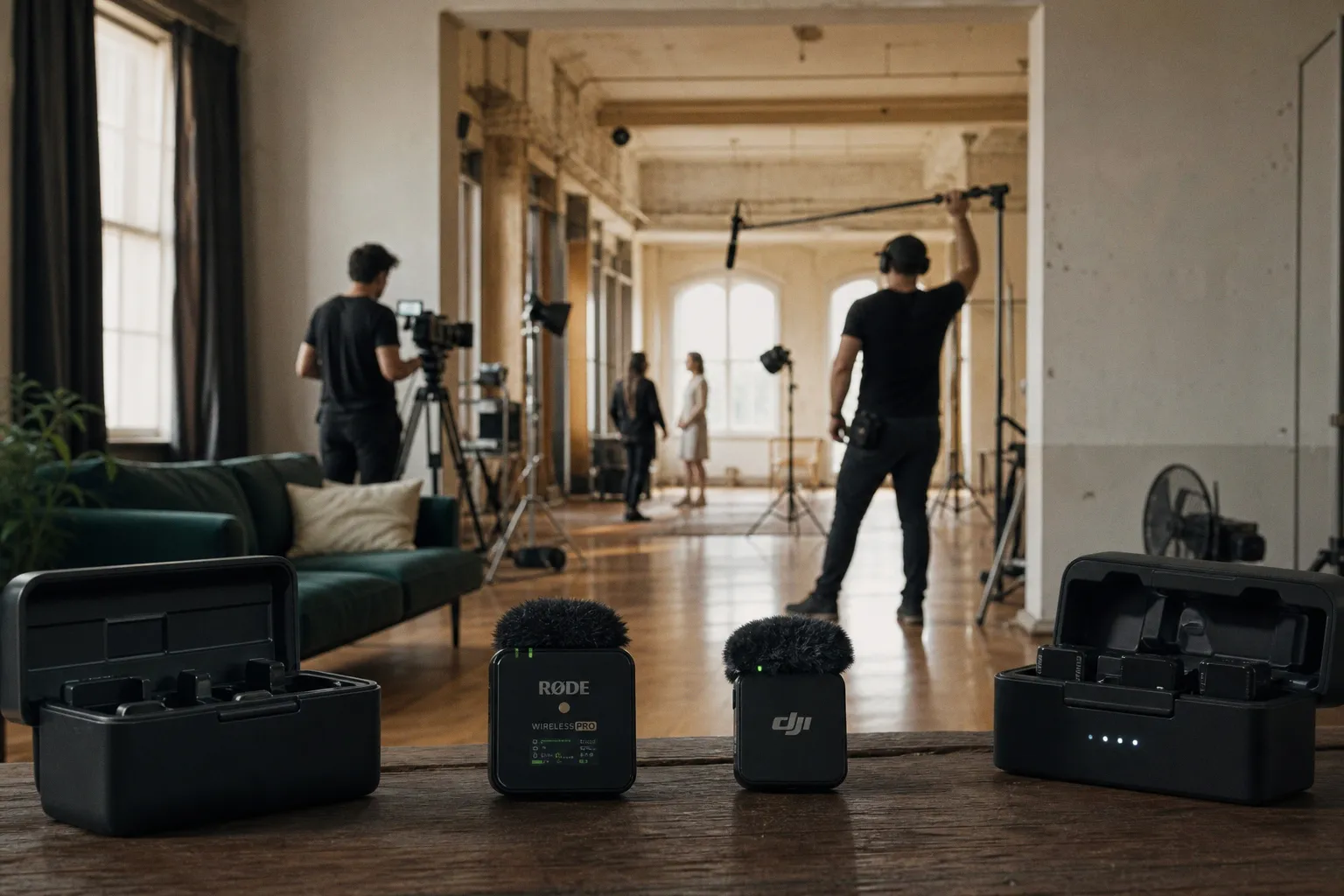
Modern compact transmitters run somewhere between 6 and 15 hours on a charge, with the longer numbers typically reserved for systems paired with a charging case. The DJI Mic 2 case extends total field time well past a working day by topping off the transmitters between set-ups. The RØDE Wireless PRO approaches the same problem in the same general way. That kind of design is what lets me send a two-person interview crew out for a full magazine shoot without doing battery math mid-day.
I want to push past the spec sheet here, because there's something about how batteries behave that brochures don't tell you:
- Lithium cells lose capacity in the cold. Pull a transmitter out of a heated car on a January morning, lay it on a frozen picnic table to start setup, and watch the apparent runtime collapse by 30%. A charging case that lives in an inner pocket regains some of that margin simply by staying warm — outdoor winter runs live or die on this detail.
- Battery degradation is real, and the manufacturers won't lead with it. Cells in compact systems tend to last 300 to 500 cycles before capacity slips noticeably. Shoot daily and you've got roughly a year of heavy use before the runtime numbers on the spec sheet stop matching what you actually get on set.
- Treat batteries as consumables, not as equipment. Build replacement transmitters into your budget on a slow rotation, the same way you'd rotate SD cards. That's the discipline that keeps the kit honest and a year-two shoot from going sideways.
Choosing the Best Wireless Lavalier Microphone for the Shoot You Actually Book
I'll skip the ten-bullet recap because you didn't come here for one. Instead, here's how the field actually separates itself at the mixing desk:
| System | Transmission | Internal Recording | Transmitter Battery | Standout Acoustic Strength |
|---|---|---|---|---|
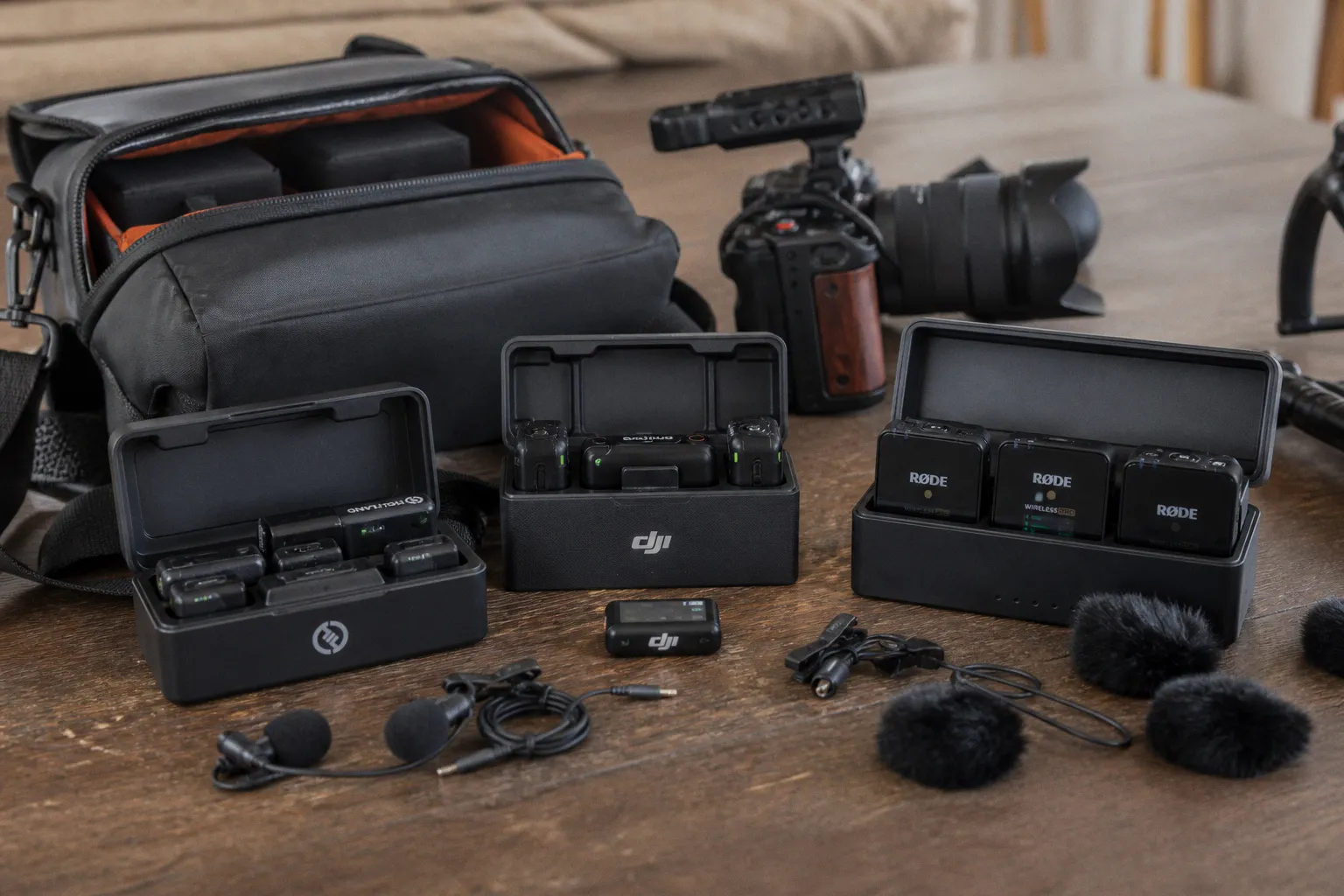
| DJI Mic 2 | 2.4GHz digital | 32-bit float onboard | ~6 hours per charge, charging case extends significantly | Wide dynamic rescue on erratic levels |
| RØDE Wireless PRO | 2.4GHz with frequency hopping | 32-bit float onboard | ~7 hours, charging case extends | Long-range stability in cluttered RF environments |
| Hollyland Lark Max | 2.4GHz digital | 24-bit / 48 kHz onboard | ~7.5 hours per charge | Aggressive environmental DSP for noisy interiors |
No single system wins on every acoustic axis. The DJI Mic 2 carries the widest safety net when dynamic range is unpredictable. The RØDE Wireless PRO earns its slot when transmission stability over distance matters more than onboard forgiveness. The Hollyland Lark Max is the right call when the shoot happens in the kind of space you wouldn't normally record in — weddings, trade shows, gym floors, breakout sessions. For creators working in the fitness and home-studio space, the audio decisions go hand in hand with the rest of the room's equipment choices, and the practical home-gym and creator-accessory round-ups at gymrabatt pair well with mobile lavalier workflows for anyone filming training content.
The right way to pick the best wireless lavalier microphone for mobile production is to ask one question first: what is the loudest, most dynamic, most unpredictable thing your talent will do on a normal day? If the answer is "laugh, whisper, walk between rooms, and trust that I'll fix it later," buy the system with 32-bit float onboard — full stop. If the answer is "deliver a 90-minute talk in one room," dynamic range matters less than battery life and self-noise floor, and the choice tilts accordingly. If the answer involves a moving subject outdoors at distance, RF stability dominates everything else.
Buy the wireless lavalier for the shoot you'll book next month. Everything else on the data sheet is biography.
Two follow-on requirements that review sites often forget to ask about. First, does the receiver hand a clean digital signal to your phone with no analog round-trip? Second, does the manufacturer sell replacement transmitters separately, so you can rotate the oldest one out before it surprises you on set? Both will save you from the kind of failure that doesn't show up on a spec sheet, in a margin cell, or in a YouTube comparison. I keep a DJI Mic 2 in my own kit for the unpredictable days. I keep a RØDE Wireless PRO for the long-range, location-heavy days. And I keep an open mind, because in twelve months the best wireless lavalier microphone will have moved again, and the only durable skill is reading the acoustic specification — not the model number.