Is This New Modular Gimbal a Professional Tool or Just a Collection of Parts?
According to No Film School, a new three-axis gimbal is being positioned as a modular, handheld-first tool for video professionals.
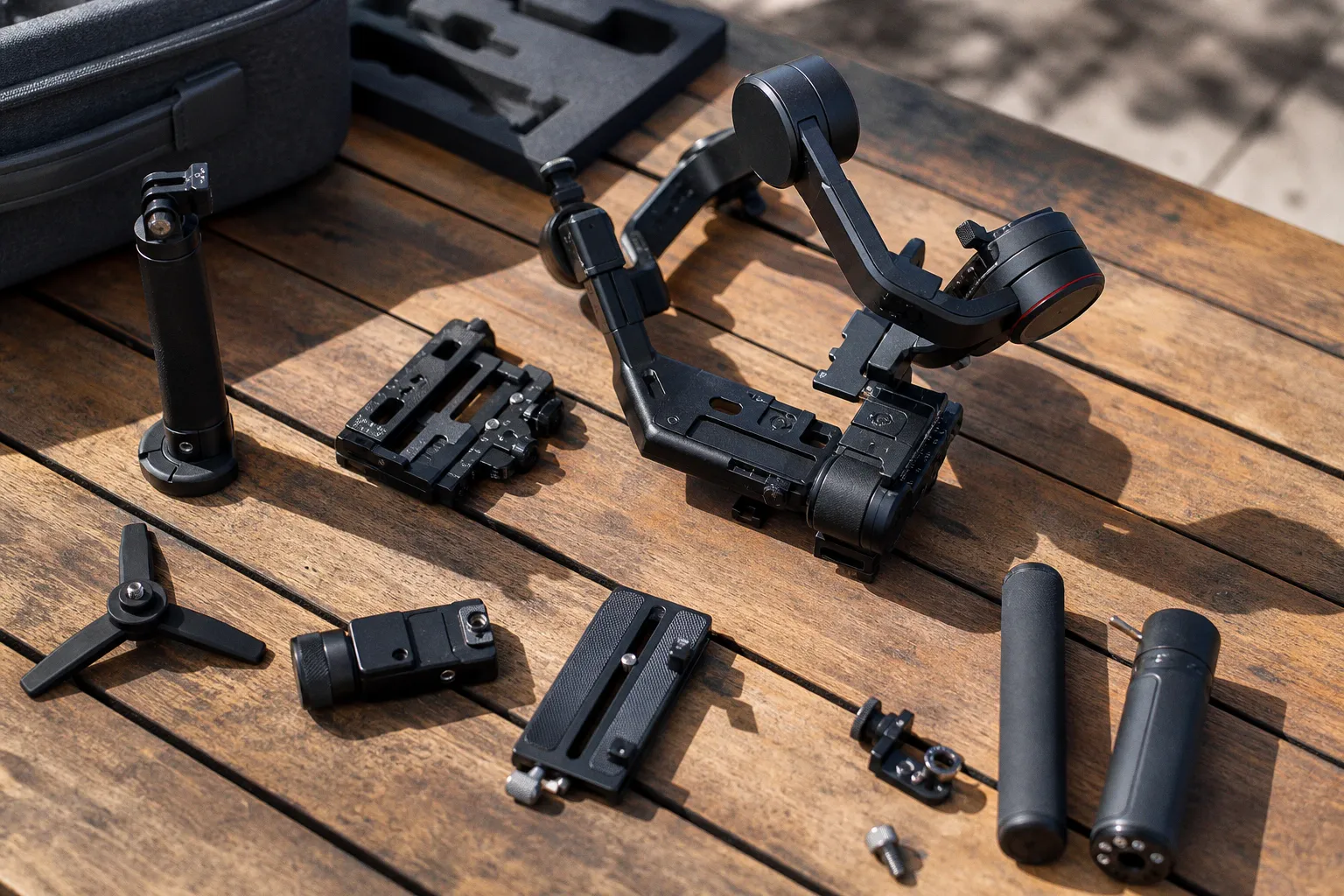
That is the entire verified specification set currently available: three-axis stabilization, modular intent, and a handheld operating premise. No payload figure, motor-torque data, battery architecture, control protocol, or camera-compatibility list has been supplied in the available material.
For working crews, that missing data is not peripheral. It determines whether “modular” means a useful rigging standard or an accessory catalogue.
The specification sheet is still the test
A three-axis layout addresses pan, tilt, and roll. It does not, by itself, establish usable stabilization performance. The relevant metrics remain unreported:
- supported camera and lens mass;
- balance travel on each axis;
- motor response under changing inertia;
- battery runtime and swap procedure;
- power-output options for camera or monitor accessories;
- physical interfaces for handles, transmitters, focus motors, or counterweights;
- operating behavior after a mode change or re-balance.
The phrase “handheld-first” also requires qualification. It may describe handling, a built-in control layout, or simply the intended use case. Without dimensions, mass, grip geometry, and power figures, there is no basis for judging fatigue, clearance around an EVF, or whether a configured build remains practical for long takes.
No Film School’s framing establishes the product category, not its tolerances.
Modularity needs a defined mechanical benefit
A modular gimbal can reduce rebuild time only when the attachment system remains stable across configurations. The useful question is not how many pieces can be mounted. It is whether a change in handle position, monitoring hardware, or lens-control hardware shifts the centre of gravity enough to require a full rebalance.
That distinction matters on sets where the camera package moves between low mode, handheld support, vehicle work, and a stripped travel configuration. Every added component changes inertia. Every change in inertia affects motor tuning and stabilization yield. A modular system that adds assembly steps without preserving balance references can be slower than a fixed chassis.
Separately, Camera Jabber reports that SmallRig has announced its Professional Outdoor Backpack (25L) 6521, with interior dividers, fold-over anti-drop baffle flaps, and modular accessory pouches for field production. That announcement confirms the continuing emphasis on modular storage around field rigs, but it does not establish any connection to the unnamed gimbal report.
What crews should hold before committing
The current information does not support a buying conclusion. Production teams should wait for a full specification sheet and test the actual configuration, not an empty gimbal body.
Check clearance with the intended camera, lens, monitor, receiver, and focus hardware. Check whether a battery swap alters balance. Check whether the rig can move between operating modes without a repeated tuning cycle. Then inspect the control response under the real payload.
Verdict: category confirmed; production suitability unconfirmed.