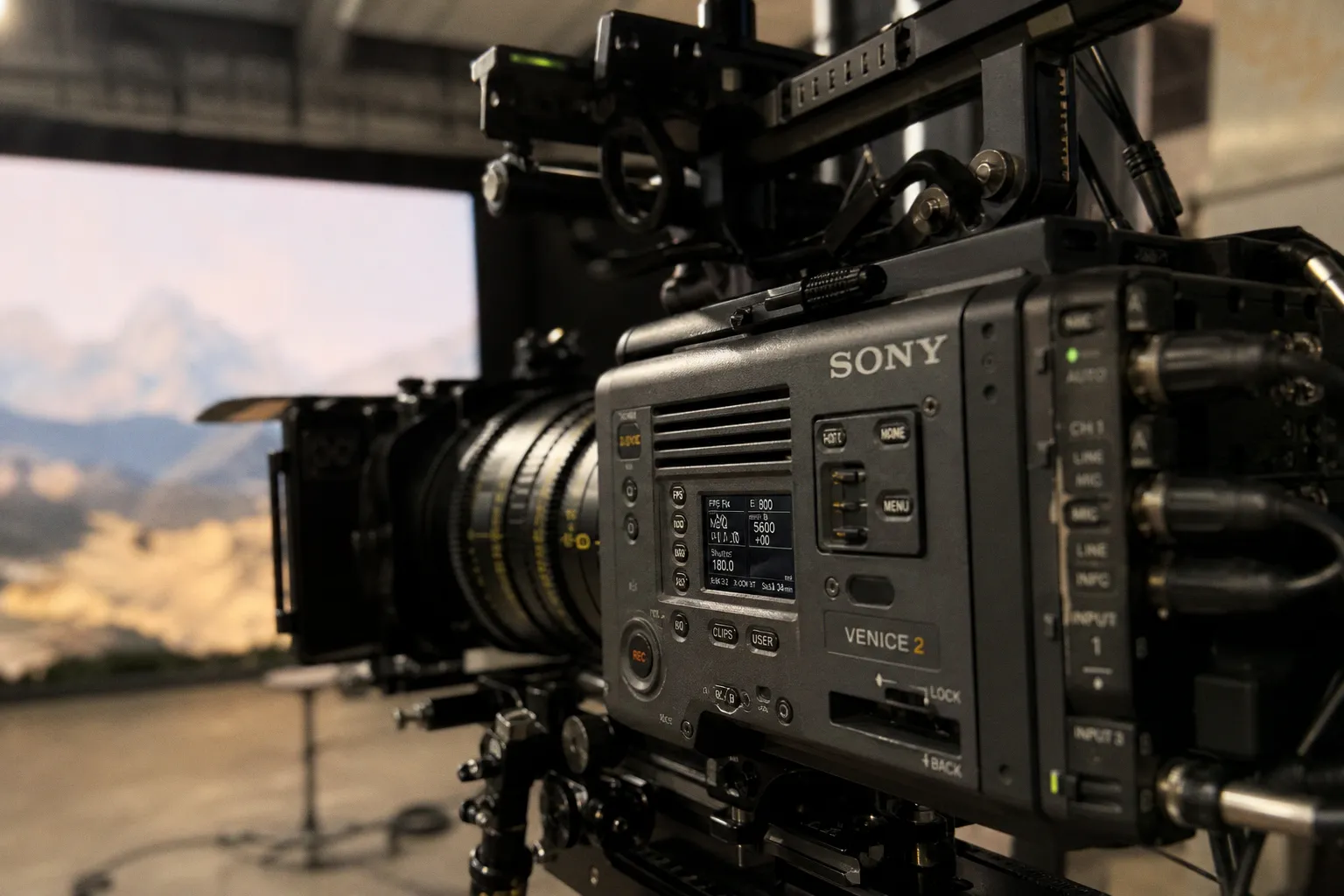
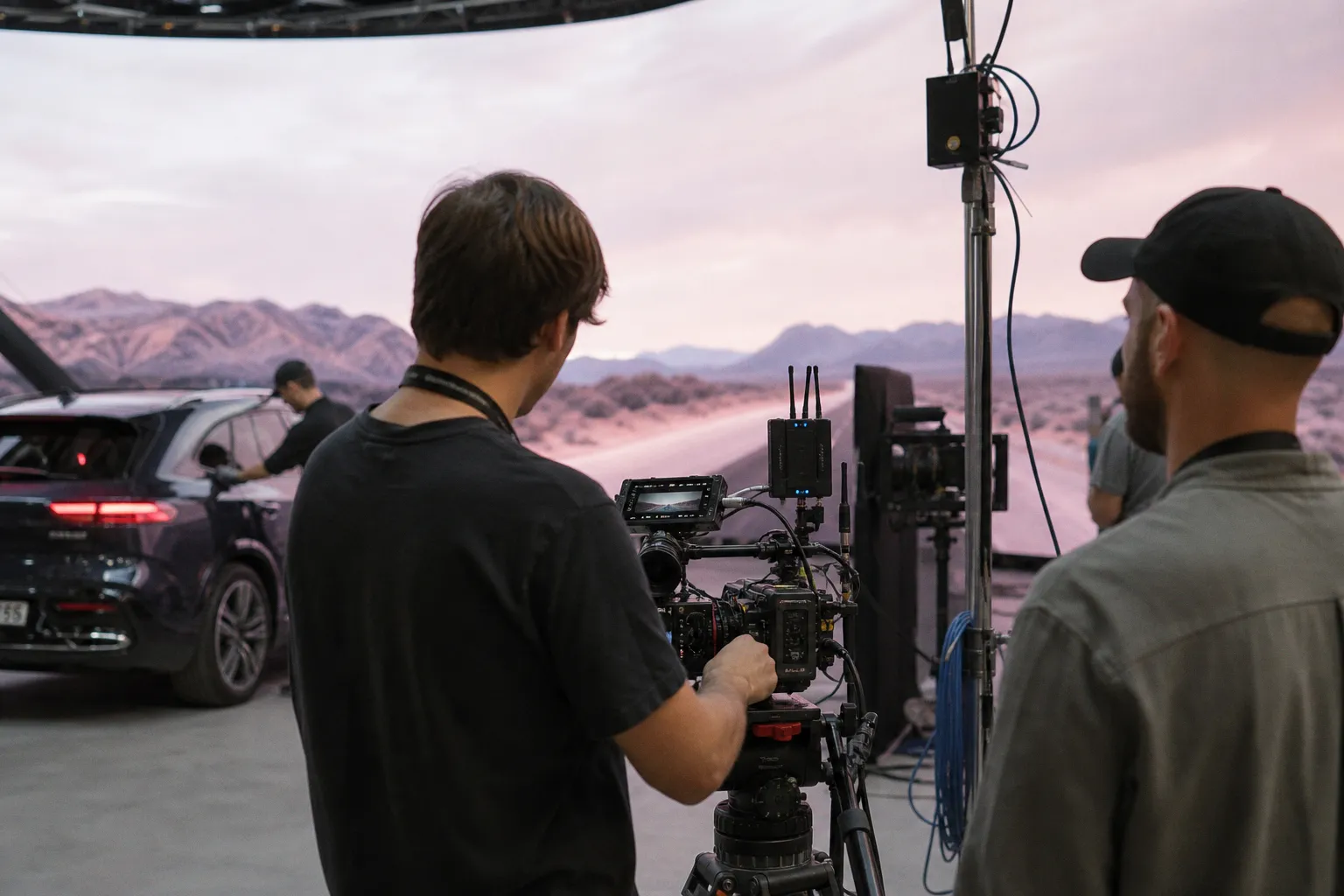
The bottleneck usually appears after a promising test day. The LED wall looked great. The tracked camera held. Unreal fed the processors without dropping frames.
Then someone opens the budget and asks the question that can freeze a production slate: should we build our own virtual production studio, or keep renting stages?
This is not a panel-price question. It is a utilization question, followed closely by a power question, a staffing question, and a “who owns the problem at 6:40 a.m. when tracking drifts?” question.
A small in-house virtual production setup can begin around $50,000. A full-scale volume can run beyond $15 million. That range is so wide because “an LED wall” is not a working virtual production studio. The wall is only one node in a much larger system: processors, media servers, camera tracking, genlock, networking, rigging, cooling, calibration, safety systems, and a crew who can conform all of it to the shot list without turning the day into a troubleshooting marathon.
Let’s separate the attractive invoice from the actual operating decision.
The 65% utilization threshold is the number that changes the conversation
There is a blunt industry rule of thumb: do not buy a permanent LED volume unless you can keep it working at roughly 65% capacity. In calendar terms, that means about 33 production weeks a year.
Not 33 weeks of “we could shoot there.” Not 33 weeks of internal pitch decks, client walk-throughs, or a director wanting to test a sunset. Paid, schedulable production time. Time that would otherwise be rented from someone else.
This is where many build-vs-rent virtual production studio spreadsheets become too optimistic. They compare a capital purchase against a weekly rental fee, then quietly assume every empty day is free. It is not. An owned stage keeps billing you when it is dark.
You have fixed costs running in the background:
- maintenance agreements and panel servicing;
- permanent technical staff or retained specialists;
- HVAC and electrical load;
- insurance, rigging inspections, and facility overhead;
- replacement planning for damaged modules, processors, and tracking components;
- software, content pipeline support, and calibration time between jobs.
If your studio has a stable stream of episodic work, automotive content, product shoots, broadcast packages, or recurring branded campaigns, ownership can become strategically powerful. You can standardize the camera package, lock your Unreal versioning, maintain repeatable node trees, and build a crew that knows exactly how the volume behaves.
If your work arrives in bursts, rental remains the more disciplined choice. You pay for access when the script needs it, rather than forcing every script to justify the building.
A virtual production studio becomes an asset only when the schedule keeps it busy. Otherwise, it is a very expensive place to store certainty.
The operational advantage matters as much as the accounting. A permanent stage lets you pre-build reliable workflows: ingest settings, lens files, tracking profiles, color transforms, playback presets, and handoff templates for post. Every repeat job gets faster because the team is not rebuilding the machine from zero.
But there is a trap here. Familiarity is not utilization. A stage your team enjoys using can still be financially underworked.
LED panels are the visible cost. The system around them is the bill.
Panel hardware commonly lands in the range of $1,000 to $3,000 per square meter. That figure gets repeated because it is easy to understand and easy to put in a deck.
It is also incomplete.
Once you add the infrastructure needed to run an actual virtual production volume, the total system cost can rise 40% to 70% above the panel quote alone. That is not vendor padding. It is the difference between a bright wall and a stage you can trust with a crew call.
A functional in-house setup needs decisions across several layers:
1. The display layer
Pixel pitch, refresh behavior, brightness, scan rate, color consistency, spare panels, processor capacity, and the geometry of the wall all affect what the camera sees. A volume designed for wide automotive reflections has a different physical and visual brief from a compact product-shoot wall.
2. The tracking layer
Camera tracking is not an accessory you attach at the end. It drives the illusion. Your tracking system, lens encoders, lens metadata, coordinate calibration, and stage survey need to agree every time the camera moves. When they do not, the background slips, parallax feels wrong, and the director loses confidence very quickly.
3. The real-time layer
Unreal Engine workstations, render nodes, synchronization, media servers, genlock, network switching, backup paths, and monitoring all need enough headroom for the heaviest shot, not merely the demo scene. A one-camera test may look stable. Add a second feed, live keying, playback, and a director’s monitor, and the weak link announces itself.
4. The physical layer
Rigging, truss, structural review, acoustic treatment, cable routing, floor finish, access doors, loading paths, and crew safety do not make glamorous slides. They decide whether the stage can turn around between productions without chaos.
5. The pipeline layer
This is where post-production gets pulled into the decision. Who prepares assets? Who validates frame rates? What is the color pipeline from camera through LED processors to dailies? Can editorial receive proxies with correct timecode? Can VFX round-trip a changed environment without breaking a conform?
A permanent volume gives you control over these decisions. It also makes every one of them yours.
| Cost area | Building an in-house virtual production setup | Renting an LED volume studio |
|---|---|---|
| Upfront cash | High capital commitment, from a modest setup to multi-million-dollar scale | Usually limited to production booking, prep, crew, and content costs |
| Technical stack | You buy, integrate, maintain, and upgrade it | The facility provides an established stack, though configuration may be less flexible |
| Capacity risk | Empty weeks remain your expense | You can scale usage to the production calendar |
| Workflow repeatability | Very high once the stage and crew are standardized | Depends on returning to the same facility and retaining prep documentation |
| Facility control | Full control of schedule, camera package, and stage layout | Subject to availability, house rules, and booked configurations |
| Failure ownership | Your team resolves it | The stage operator carries much of the infrastructure burden |
The panel number may start the conversation. It should never end it.
Power, heat, and maintenance do not care about your pitch deck
Large LED walls can draw roughly 100 to 500 kilowatts during operation. Depending on local energy pricing and the size of the wall, electricity can land around $50 to $250 per hour.
That is before we get to the uncomfortable detail: LEDs turn a meaningful portion of that power into heat, and heat is a workflow problem. Your HVAC system has to keep the room within operating tolerance while a wall, processors, render machines, lighting fixtures, camera bodies, and people are all working at once.
For an existing facility, infrastructure conversion can add from about $50,000 for basic work to more than $500,000 for a complex transformation. Electrical service, cooling capacity, acoustic control, loading access, and structural rigging can each move the project into a different budget bracket.
This is where I would slow the team down and ask a less exciting question: what happens on day 43, not day one?
On day one, every vendor is present. The wall is clean. The calibration is fresh. The tech team has the room memorized.
On day 43, you may have a panel with a color discrepancy, a tracking profile that no longer matches the lens package, a server update that should not have been installed, and a client who has booked a half-day only. If your production model cannot support an experienced technical operator and a maintenance plan, the ownership case weakens fast.
Annual maintenance contracts commonly run around 8% to 15% of the hardware value. That number should sit in the same spreadsheet as your projected stage revenue, not in a footnote labeled “future operations.”
Milestone: separate creative utilization from technical utilization. A wall may be booked, but if each job requires a day of reconfiguration and calibration, your practical availability is lower than the calendar suggests. Build those prep and reset days into the model.
The same applies to content. An LED volume does not eliminate post-production; it moves some decisions earlier. Environments need optimization. Camera frustums need testing. Color needs to be managed from the virtual scene to the camera original. Editorial needs proxy workflows that preserve metadata cleanly enough for a later conform.
You are not buying fewer decisions. You are buying the ability to make them sooner.
Renting is not one market: standing stages and pop-up volumes behave differently
“Renting an LED volume studio” sounds like a single line item. It is not.
A standing stage is a permanent facility with a settled technical stack, trained crew, and infrastructure already carrying the weight of the work. For straightforward 2D plate playback, such as controlled driving scenes, a standing stage can sit in the neighborhood of $35,000 to $50,000 per week.
A medium pop-up volume can reach roughly $100,000 to $250,000 per week because you are paying for transport, build, rigging, technical setup, calibration, and strike. The wall is traveling to your logistics problem, and logistics are expensive.
Daily rates for virtual-production-ready LED walls or smaller volumes often fall between $9,000 and $25,000. In major production hubs, full volumes with tracking can move substantially higher; London pricing, for example, can range from £5,000 to £30,000 per day depending on scale and package.
That does not automatically make a standing stage “cheap.” It makes its costs legible.
With a standing stage, you are renting an operating environment. The tracking system has likely been used before. The processors are patched. The HVAC has already survived real shooting days. The crew knows which calibration steps are routine and which warning signs mean stop before the take.
With a pop-up, you gain location flexibility and potentially more control over the production footprint. But you also introduce more interfaces: new power, new rigging, new room dimensions, new network conditions, new environmental variables. Every interface is another place for the timeline to slip.
The cheapest LED day is not the lowest day rate. It is the day that does not become a two-day technical recovery.
Milestone: rent the right scale, not the maximum scale. A product insert, a tabletop commercial, or a tightly framed talent scene may need a well-configured LED wall and disciplined playback—not a heroic wraparound volume. Conversely, a reflective vehicle or a wide interactive environment can expose every shortcut in a smaller setup.
The script should define the stage, not the other way around.
The real decision is workflow ownership
When teams say they want to build, they often mean one of three different things:
- they want predictable access to a stage;
- they want to stop losing time to unfamiliar rental workflows;
- they want to sell virtual production as a service.
Those are different business cases. Do not use one answer for all three.
If you primarily need access, negotiate a recurring block with a standing facility. You may get preferred scheduling, a familiar crew, and repeated technical configuration without owning the depreciation and maintenance exposure.
If you need workflow control, start by standardizing your portable pipeline. Build a show bible for lens data, color transforms, naming conventions, Unreal project versions, playback codecs, take metadata, proxy generation, and VFX turnover. A disciplined crew can carry a stable workflow into a rented studio. An undisciplined crew can make an owned studio feel like a different facility every week.
If you plan to sell stage time, treat the volume as a business unit, not a creative trophy. Who is your target client? What does the stage do better than existing facilities? How will you staff it? What is the booking model? How many idle days can the company absorb? And are you prepared to tell a client “no” when their request threatens the technical integrity of the stage?
That last question matters. Rental facilities have something many new owners underestimate: operating boundaries. They know what can be done safely, what needs a prelight, and what requires a separate test. An in-house team must develop the same discipline.
A practical build-versus-rent decision pass
Before signing a lease, buying panels, or booking a multi-week stage block, walk the slate through these five questions:
1. Can we genuinely fill about 33 production weeks?
Count committed and realistically forecast work. Do not count speculative projects twice. If the answer is no, rental is usually the more flexible financial position.
2. Do our productions repeat enough to benefit from a fixed configuration?
Recurring formats, fixed camera packages, consistent deliverables, and returning clients strengthen the ownership case. One-off jobs with radically different technical needs do not.
3. Is our facility ready for the electrical and thermal load?
If the building needs major power, HVAC, and rigging upgrades, add that cost before comparing it with rental rates. Do not let the LED hardware quote masquerade as the project budget.
4. Do we have technical leadership beyond the installation?
You need people who can manage calibration, tracking, render performance, color, signal flow, and failure recovery. The installation is the start of operations, not the finish line.
5. What happens to post when the volume changes the shoot?
Define how camera originals, witness feeds, tracking data, Unreal takes, LUTs, and proxies travel through editorial and VFX. If the metadata breaks, the conform becomes expensive precisely when the schedule has no room left.
Build only when the stage serves the slate, not the sales deck
There is no universal winner in the build vs rent virtual production studio decision.
Renting is the intelligent choice for companies with uneven volume, changing creative requirements, limited facility infrastructure, or a desire to test the workflow before committing capital. It buys flexibility and access to mature operating teams.
Building makes sense when your production calendar is genuinely dense, your work benefits from repeatable technical conditions, your facility can carry the load, and you are ready to operate a stage every day—not merely own one.
The best first move is often less dramatic than a purchase order. Rent the same standing stage across several productions. Track the actual costs: prep hours, shoot hours, reset days, technical incidents, post handoff quality, client demand, and crew overtime. Then compare those numbers with a full ownership model that includes maintenance, power, staffing, and infrastructure.
Prevent the expensive surprise before it reaches the timeline:
- model occupancy against the 65% threshold using real booked work;
- budget the full system, not just LED panels;
- price electrical, HVAC, rigging, and maintenance as operating realities;
- test your tracking-to-post metadata path on a small job before scaling;
- choose standing stages for repeatable work and reserve pop-ups for cases where location flexibility truly earns its cost.
A virtual production studio is not a shortcut. It is a production system. Build it only when you are ready to keep that system moving.