World Video & Vision Cards - Market Analysis, Forecast, Size, Trends and Insights
IndexBox puts the global video and vision cards market on a 2026–2035 expansion track, with demand tied less to generic display hardware and more to acquisition, preprocessing, and edge inference.
The card is now part of the imaging pipeline, not an accessory
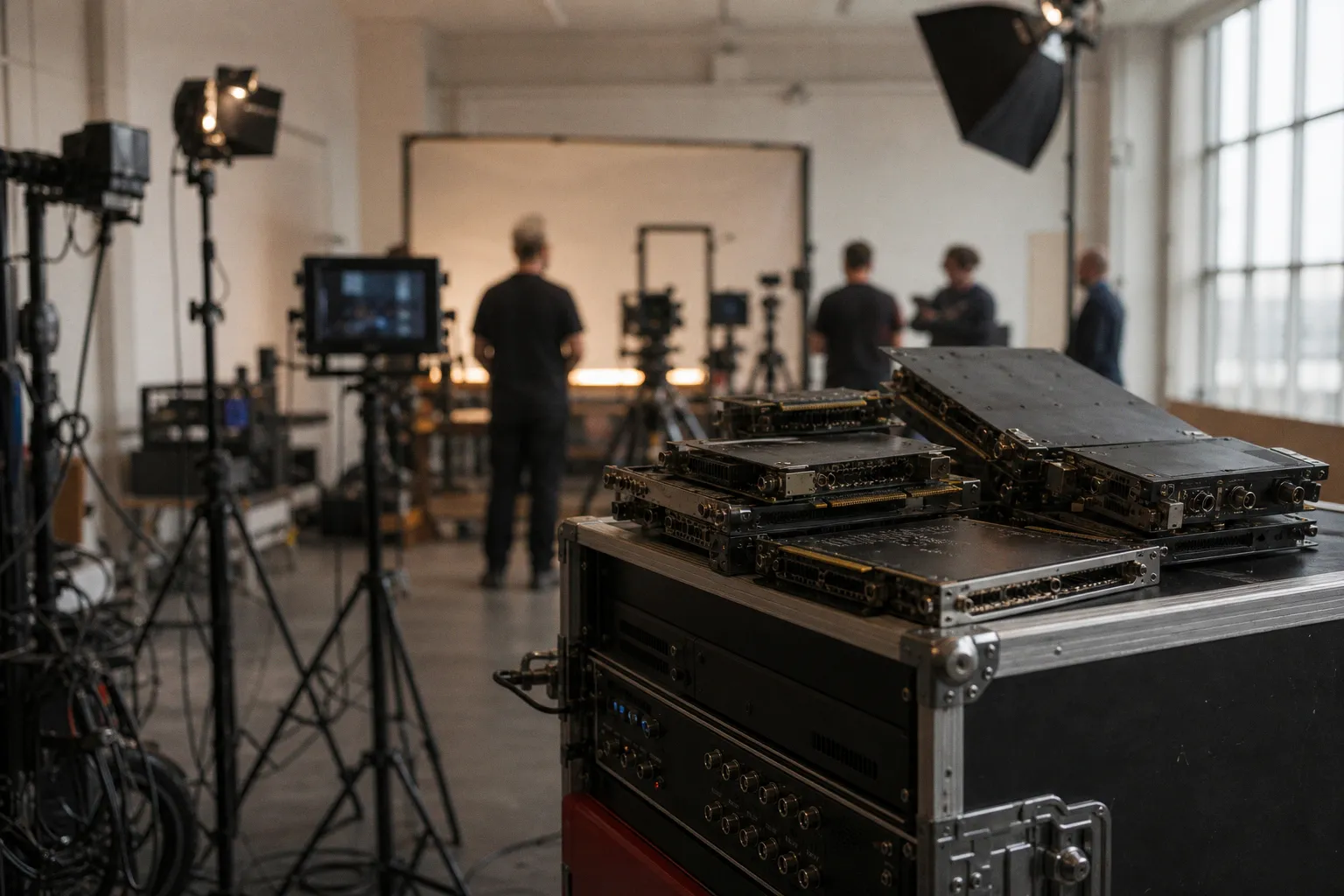
The IndexBox report frames video and vision cards as the acquisition and preprocessing layer in real-time imaging systems. That matters because the bottleneck is no longer only sensor size, lens coverage, or codec efficiency. It is increasingly interface bandwidth, onboard processing, and latency tolerance.
The report points to demand from industrial automation, semiconductor fabrication, electronics assembly, OEM integration, maintenance, smart logistics, and precision manufacturing. Those are not cinema-camera categories, but the overlap with production technology is obvious: multi-camera capture, machine-vision inspection, real-time analysis, and AI-assisted quality control all stress the same electrical limits.
Key technical pressure points cited in the report:
- AI-driven quality control is increasing demand for onboard processing.
- On-card processing can reduce latency and bandwidth requirements.
- Premium cards with FPGA or DSP processing, multi-camera support, and high-speed interfaces are expected to outpace standard-grade cards.
- The product mix is shifting away from legacy Camera Link toward higher-bandwidth CoaXPress and GigE Vision standards.
For anyone building camera arrays, virtual production capture rigs, volumetric stages, robotics-driven inspection, or high-frame-rate lab systems, this is the part to watch. The camera body may be available. The lens may be in stock. The capture card with the correct interface, firmware tolerance, certification profile, and thermal envelope may not be.
The forecast is bullish, but the supply chain is not clean
IndexBox says the market is positioned for sustained expansion through 2035. Under its baseline scenario, it forecasts high-single-digit CAGR through 2035, with the market index reaching about 210 by 2035 using 2025 as 100.
That is a strong demand curve. It is not a clean availability curve.
The same report flags structural supply concentration in Taiwan, China, and the United States for FPGAs, image sensors, and high-speed connectors. It also says lead times for advanced cards have exceeded 20 weeks in recent cycles. Supply-side constraints for high-bandwidth FPGAs and DRAM are expected to ease gradually after 2028 as new fabrication capacity comes online, but certification cycles including CE, FCC, and UL are still expected to slow rapid vendor entry.
That combination is the practical issue. A production engineering team can standardize on a camera interface faster than the supply chain can normalize around it. CoaXPress-compatible cards are forecast to grow 2–3 percentage points above the market average, according to IndexBox. That suggests stronger demand for the exact boards most likely to sit in premium inspection and multi-camera capture builds.
Procurement should treat these cards like sensors or lenses with long tolerance windows. Not like commodity PCIe parts.
What to verify before locking a system design
The report says Asia-Pacific holds the largest regional demand share, supported by electronics manufacturing and semiconductor fabs, followed by North America and Europe. Latin America and the Middle East & Africa are described as smaller but growing markets, driven by logistics automation and oil and gas inspection. Industrial automation is listed as the largest end-use segment, at an estimated 38% of global demand.
That does not automatically translate into better availability for media production buyers. It may mean the opposite. Large industrial customers can absorb allocation first.
Before specifying a capture or vision subsystem, verify the unglamorous metrics:
- Interface roadmap: Camera Link, CoaXPress v2.0, or GigE Vision.
- FPGA or DSP requirement, if preprocessing cannot move to the host GPU.
- Multi-camera synchronization tolerance.
- PCIe lane budget and host thermals.
- Lead time for the exact board revision, not just the product family.
- Certification status for the deployment region.
- Replacement availability over the expected service life.
Security Informed has also surfaced a 2026 forecast for the video surveillance market, but the available snippet does not provide enough detail to connect it directly to vision-card demand. Treat it only as a neighboring signal: surveillance, automation, and industrial imaging are all pushing more pixels through more constrained hardware paths.
Verdict: this is a favorable market for board vendors, but a tighter one for system builders. If your workflow depends on deterministic capture, low-latency preprocessing, or multi-camera ingest, specify the card early—or redesign around what can actually ship.