Smart Camera Market Growth and Sony RX10 V AI Performance
The global smart camera market equipped with neural processing units is projected to reach $29.06 billion by 2030, growing at a 20.8% CAGR, per a Yahoo! Finance Canada report.
The silicon delta
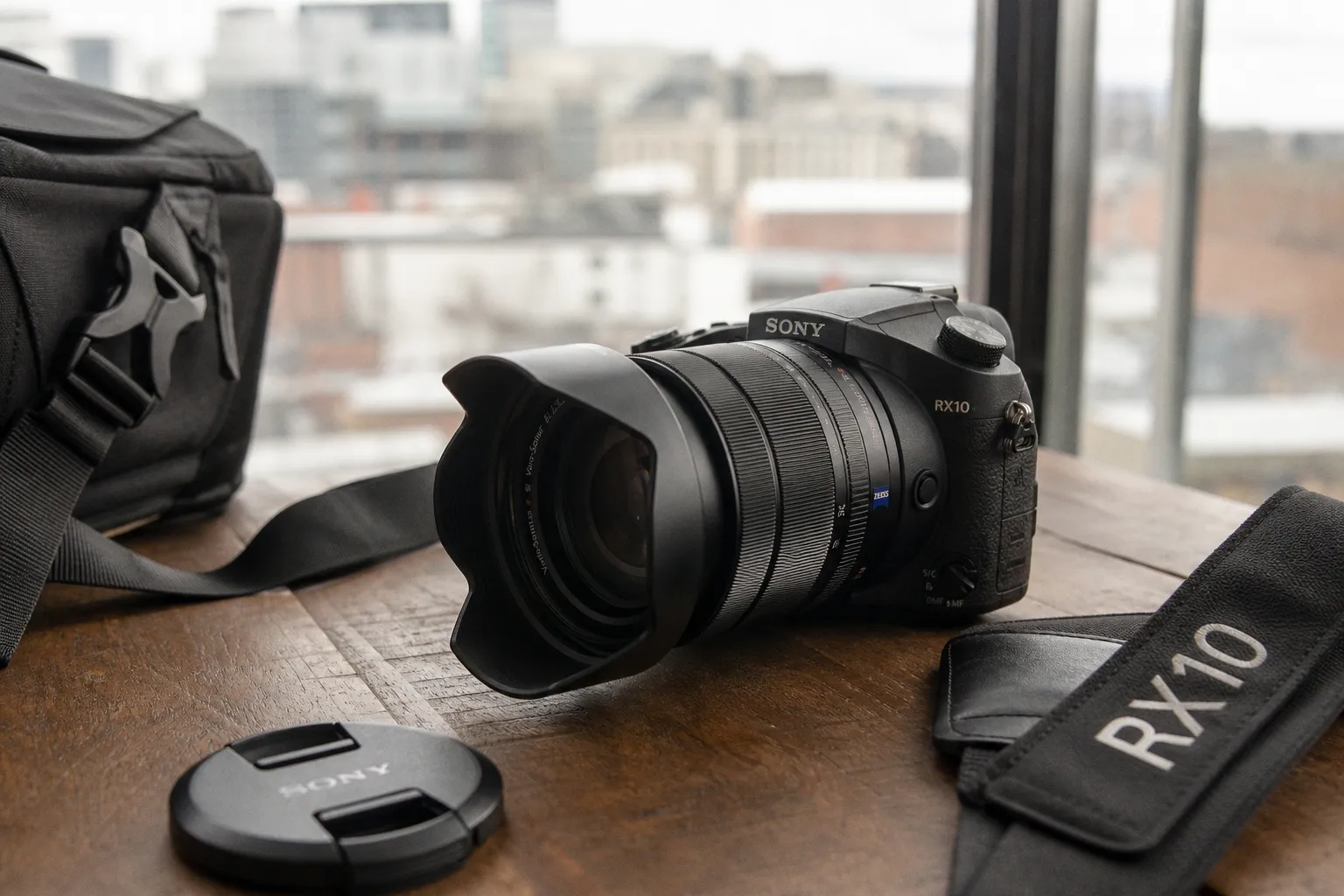
Sony kept the same 20.1MP one-inch imager and the 24–600mm f/2.8–4 equivalent zoom optics from the 2017 RX10 IV. The change lives entirely in the processor. The Bionz XR with its on-chip AI unit drives 60 AF calculations per second across 575 phase-detection points covering 70.6% of the frame. Burst rate jumps to 30fps blackout-free — matching the A7R VI.
Subject recognition AF is the spec that matters for long-lens acquisition work — birds, wildlife, run-and-gun doc. Early hands-on testing reports the system handles birds and insects fairly well, though already-in-flight subjects produce more misses than hits. That's a tolerance worth benchmarking against your own hit-rate requirements before committing.
Video specs worth tracking
Full-sensor-width 4K 60p. Cropped 4K 120p. S-Cinetone, S-Log3, and LUT import support — the same gamma curve options Sony gates behind its cinema-adjacent Alpha bodies. Noise reduction and color rendering show improvement over the prior generation, per Sony's claims. Battery life jumps roughly 50% to a rated 630 shots.
For a bridge camera with an unswappable 25x zoom, those are non-trivial video metrics. The 1,111g body weight sits well below a mirrorless kit covering the same 24–600mm focal range with separate glass. The lens hits near-half-macro reproduction ratios — 0.42x at 24mm, 0.49x at 600mm.
What the market projection actually signals
The $29.06 billion figure is a market-research headline. No methodology breakdown is available in the source. Treat it as directional, not calibrated. The 20.8% CAGR, however, aligns with observable silicon trends: on-device inference is displacing cloud-dependent processing across imaging, automotive, and surveillance verticals.
For cinematographers and production crews, the practical read is straightforward. NPU-equipped cameras will increasingly handle AF, exposure metering, scene recognition, and noise reduction locally, in real time, with lower latency than DSP-only pipelines. Sony's RX10 V is an early consumer-tier proof of concept. Expect the same AI silicon architecture to migrate into cinema and hybrid bodies within 12–18 months.
Institutional capital is already positioning around these hardware-adjacent growth sectors at scale — the kind of capital flow that accelerates R&D cycles and compresses product timelines.
Sony hasn't disclosed pricing for the RX10 V. That's the missing variable. If the MSRP lands high, the value calculation against a mid-tier mirrorless body plus telephoto zoom gets tight fast. One to watch.