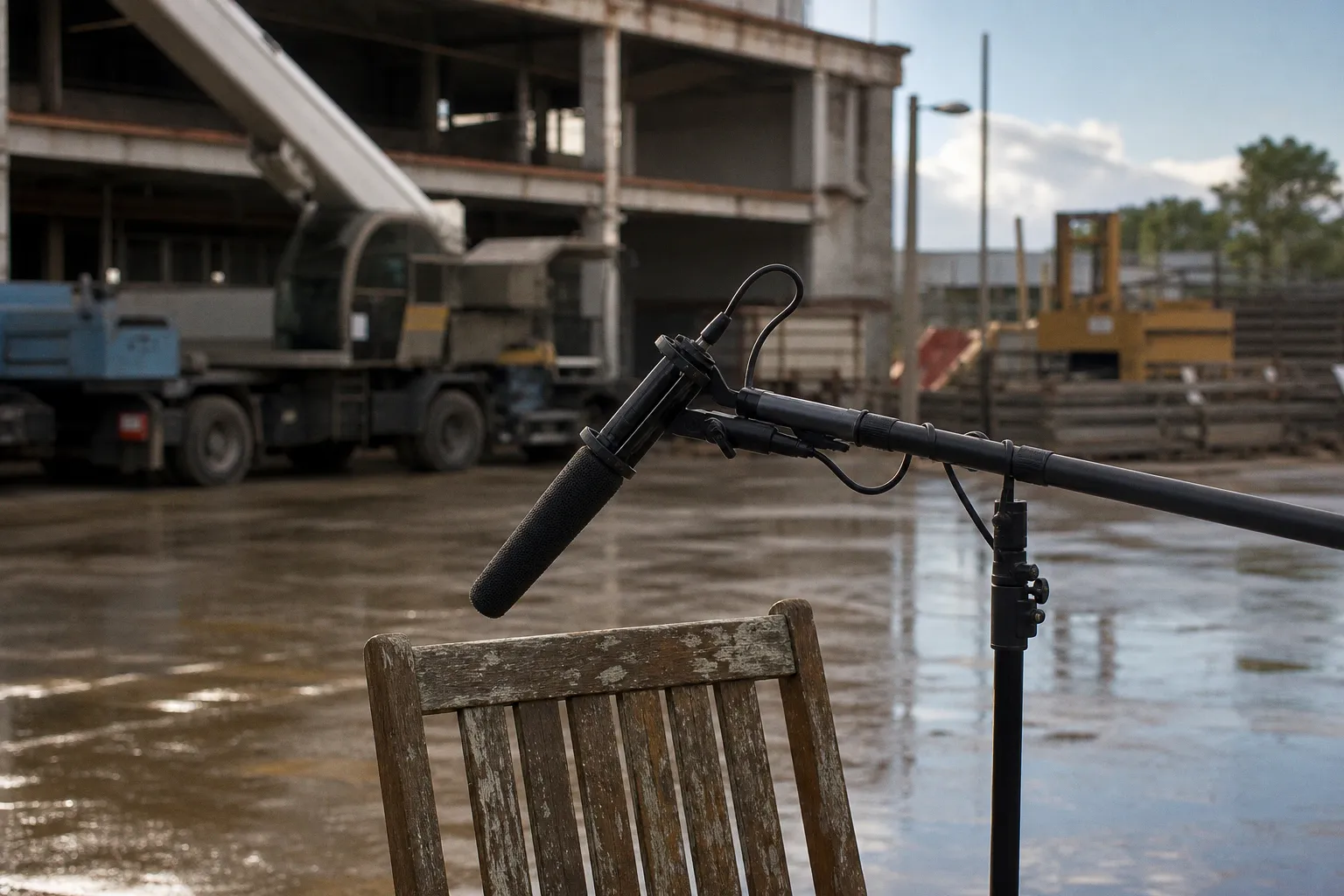
A shotgun microphone can reject a voice from the wrong side of the street and still betray you with a ceiling reflection six feet above the actor’s head. That is the cruel little truth behind every good shotgun microphone choice: directionality is not magic.
I have stood under trees with a boom pole aching in my wrists, listening to a lavalier rustle like dry paper under a jacket while a shotgun mic held the scene together with clean, forward dialogue. I have also sat at the mixing desk and cursed the same class of microphone because an untreated room turned every consonant into a phase-smeared little ghost. The microphone was not “bad.” The choice was bad. That distinction matters.
The shotgun promise: rejection, not isolation
A shotgun microphone earns its reputation through an interference tube: that slotted barrel in front of the capsule that makes the mic highly directional. Sound arriving on-axis — the actor’s voice, if the boom operator is doing their job — reaches the capsule in a coherent, usable way. Sound arriving from the sides enters the slots at slightly different times, and those tiny time differences create cancellation.
That is the basic bargain. You get a lobar or supercardioid pattern with strong off-axis rejection, especially useful when recording outdoor dialogue near traffic, generators, distant crowds, wind movement through trees, or the endless electrical whine of locations that were scouted with eyes instead of ears.
And yes, I mean that sharply. Too many productions still treat location audio as a cleanup problem for post. It is not. Noise reduction plugins are extraordinary tools, but they are not absolution. When a microphone captures dialogue with a high noise floor, smeared transients, or ugly reflected comb filtering, the mix does not merely become harder. It becomes smaller. The voice loses breath, teeth, chest, intention.
A good shotgun microphone is not the one with the most aggressive rejection printed on a spec sheet. It is the one whose rejection behaves musically enough when the real world starts misbehaving.
Directionality is useful only when the sound you reject is uglier than the coloration you introduce.
That is why I start every shotgun discussion with the environment, not the brand badge.
The physics of interference: why the tube is both hero and villain
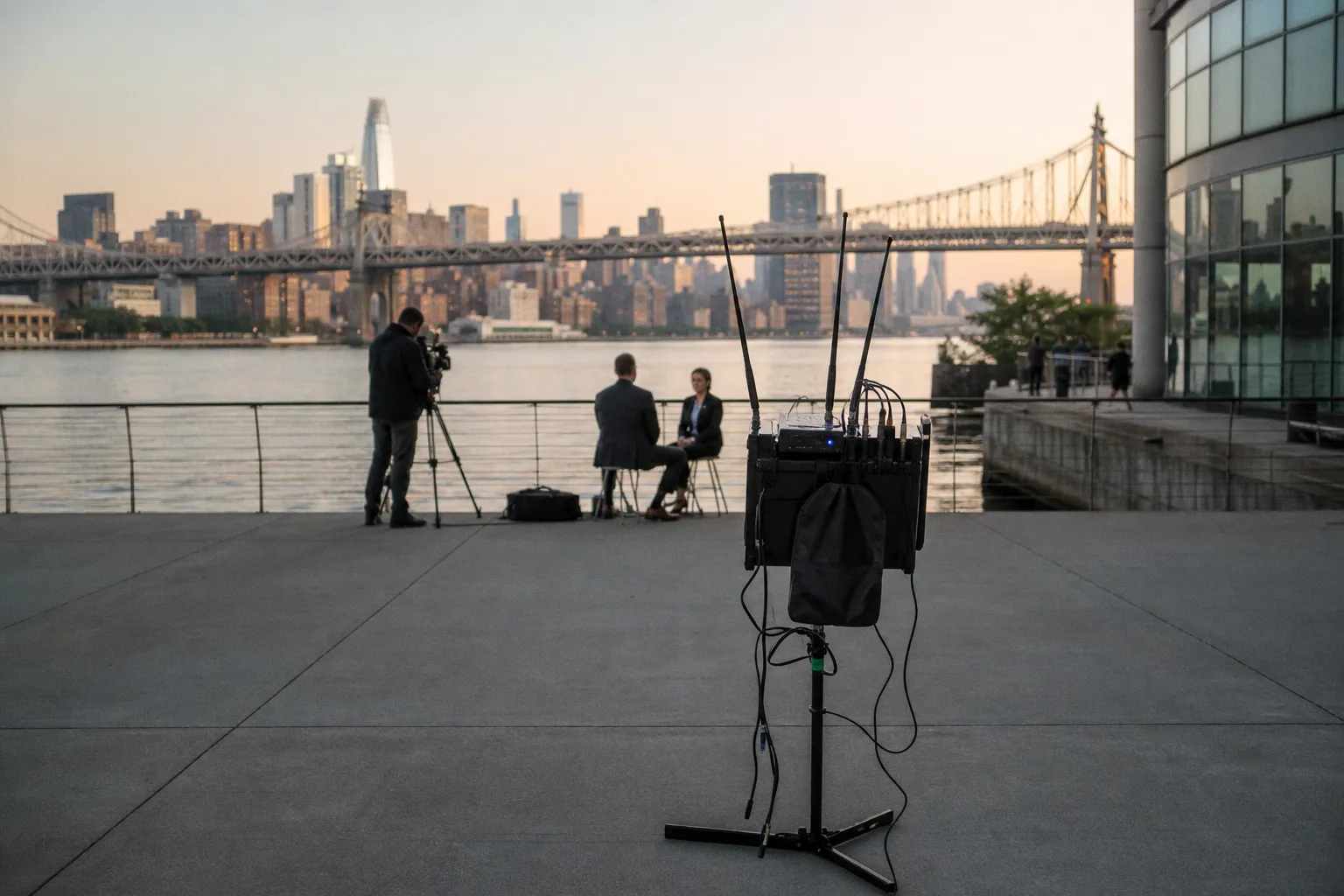
The interference tube is a clever acoustic filter. It helps the microphone discriminate by arrival angle, which is precisely why a shotgun microphone for outdoor dialogue can make a scene feel controlled even when the location is breathing, buzzing, and grumbling around it.
Outdoors, reflections tend to be less immediate and less dense than they are inside a hard room. A passing car, a river, a distant air conditioner, a crew member shifting weight on gravel — these are off-axis events the shotgun can often push down enough for dialogue to sit forward. You still hear the world, but the voice has a spine.
The problem begins when filmmakers confuse “directional” with “surgical.” A shotgun mic does not extract dialogue like a scalpel. It changes the ratio between wanted and unwanted sound. It also changes the tone of off-axis sound, sometimes gracefully, sometimes with a hollow, phasey edge that becomes very obvious in headphones.
The frequency response matters here. Many shotgun microphones advertise a standard 20 Hz–20 kHz range, but that broad range tells you almost nothing about how the mic will handle the critical dialogue band. Human speech carries intelligibility heavily in the upper midrange — those consonant edges, sibilants, lip noises, and small transients that tell the brain what word was spoken rather than merely that a person made sound. If the microphone has brittle presence peaks, the voice can become piercing. If the low mids are too loose, proximity and boom handling can make the dialogue woolly.
Here is the practical way I listen when comparing shotguns from the boom position:
1. On-axis voice character. I want consonants to arrive cleanly without turning every “s” into steam and every “t” into a needle. The mic should carry chest and mouth detail without exaggerating either.
2. Off-axis coloration. I ask someone to speak while drifting 30, 60, and 90 degrees away from the tube. Rejection is nice; ugly rejection is a post-production debt.
3. Handling and wind sensitivity. A microphone that sounds lovely on a stand but thumps through a pole or panics in a breeze will punish the recordist all day.
4. Noise floor in quiet speech. Whispered or intimate dialogue exposes self-noise quickly. If the mic hisses under the performance, the scene loses closeness.
5. Recovery from movement. Real actors move. The polar pattern must forgive tiny aiming errors without making each head turn sound like a different take.
That last point is where many budget “best shotgun mic for film” recommendations become slippery. A mic can sound impressive in a controlled comparison and still be brutal on set if its off-axis response is jagged. Film dialogue is not a laboratory tone. It is bodies, fabric, breath, weather, blocking, and the boom operator’s shoulders slowly turning to stone.
Why the Sennheiser MKH 416 became a location-audio legend
There are few microphones more mythologized in film sound than the Sennheiser MKH 416, and for once the mythology has a real acoustic and practical foundation. It is widely treated as an industry standard for outdoor location recording because it combines a tight, useful directional pattern with RF-condenser technology that is notably resistant to humidity.
Humidity is not a romantic problem. It is the wet little saboteur inside early call times, coastal locations, rain covers, cold nights, breath, fog, and tropical exteriors. Conventional condenser designs can become noisy or unstable when moisture finds its way into the wrong places. RF-biased condenser technology is prized because it tends to behave more reliably in damp conditions.
This does not mean every RF-condenser shotgun is automatically the right mic, nor does it mean a non-RF shotgun will fall apart at the first cloud. But when I am choosing a shotgun microphone for outdoor dialogue on a job where the weather can change faster than the schedule, reliability becomes part of sound quality. A beautiful take ruined by moisture crackle is not beautiful. It is unusable with better adjectives.
The MKH 416 also has a recognizable forwardness in the presence range. Some mixers love it because it helps dialogue cut through location beds. Some find it a little assertive on certain voices. I understand both reactions. In a dense exterior scene, that assertive edge can be a gift. On a very bright voice, aimed too close and too frontal, it can become tiring. Again: the good shotgun microphone is not an abstract trophy. It is a match between microphone, voice, space, weather, and final mix.
| Parameter | What I listen for outdoors | Why it matters in the final mix |
|---|---|---|
| Polar behavior | Strong front focus without grotesque side tone | Keeps dialogue present while reducing traffic, crew noise, and ambience |
| Humidity reliability | Stable output without sputter, hiss, or crackle | Protects takes in damp, coastal, rainy, or foggy conditions |
| Presence response | Clear consonants without harsh sibilance | Helps speech remain intelligible under music and effects |
| Low-frequency control | Manageable rumble with proper wind protection | Prevents traffic, handling, and boom movement from eating headroom |
| Self-noise | Preferably below 15 dB-A for professional film work | Preserves quiet performances and intimate scenes |
That 15 dB-A self-noise threshold is not decorative. In professional film work, a microphone below that region is generally preferred because quiet dialogue can sit above the mic’s own electronic hush. Once self-noise becomes audible, post tools can reduce it, but they also tend to sand away the delicate breath and room tone that make a performance feel physically close.
The indoor trap: where shotguns start lying to you
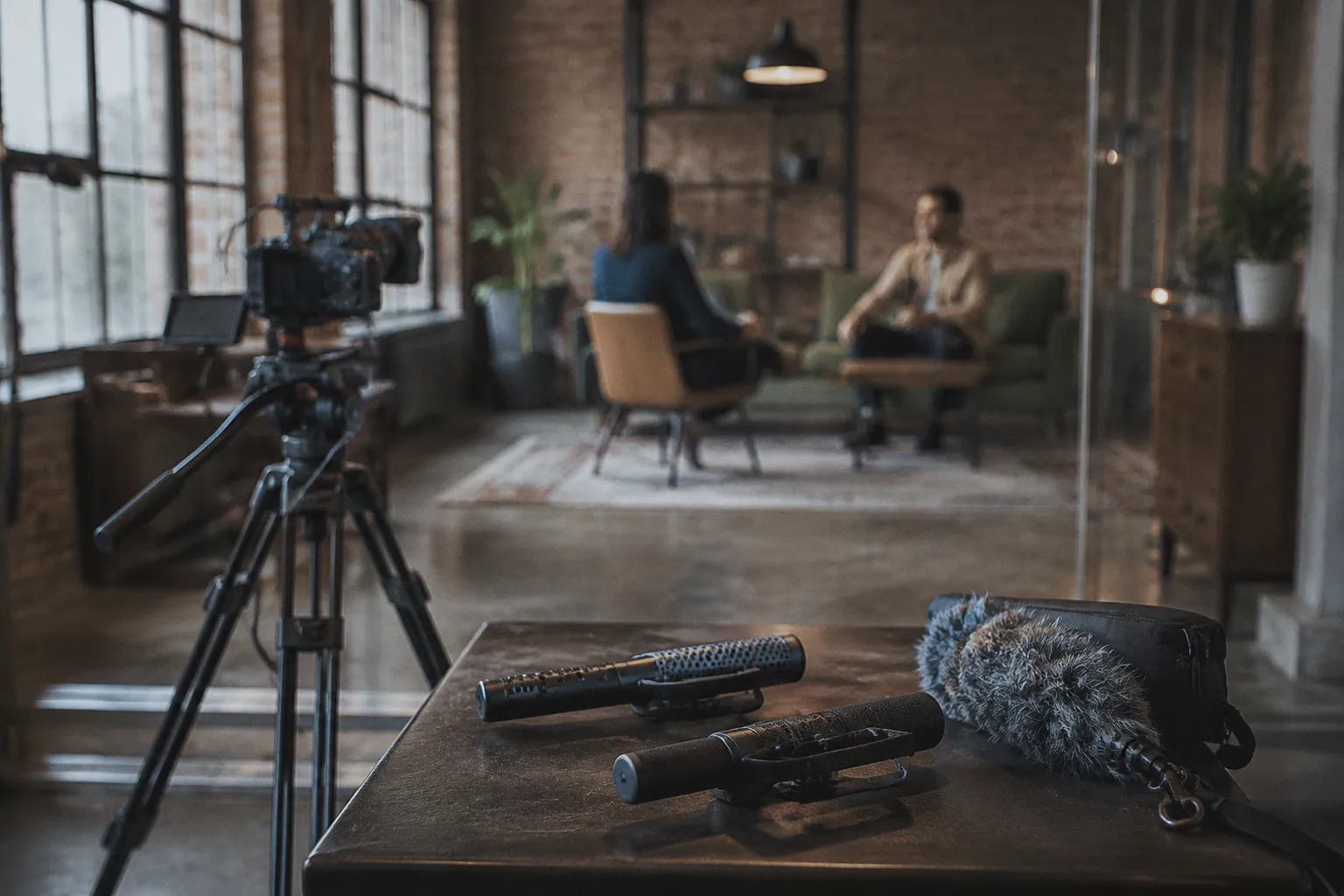
The most expensive mistake I hear from newer filmmakers is using a long shotgun indoors because it looks like what a film set should use. Untreated interiors are where the interference tube can turn from friend to nuisance.
Hard walls, ceilings, windows, floors, tables — they all send reflections back into the microphone at slightly delayed times. The interference tube does not know which delayed sound is “bad room” and which is “useful voice.” It reacts according to physics. Reflected speech arrives from different angles, enters the slots, and creates phase cancellation. The result can be hollow, comb-filtered dialogue: a voice that seems close but strangely scooped, nasal, or unstable.
I have heard indoor shotgun tracks that looked healthy on meters and still felt wrong in the edit. The peaks were there. The waveform had confidence. But the ear caught the damage immediately: consonants blurred, vowels changed color as the actor moved, and the room tone clung to the voice like damp cloth.
For untreated interiors, a shorter hypercardioid or supercardioid boom mic is often a better tool than a classic interference-tube shotgun. Not always, not religiously, but often. The shorter design typically interacts with reflections in a more natural way. You may get less extreme reach, but you also get fewer phase scars.
This is the part where I become slightly tiresome at pre-production meetings, because I ask what the room sounds like before I ask what camera package is coming. Low ceiling? Bare plaster? Glass wall? Wooden floor? Air conditioner that cannot be switched off? Restaurant refrigerators? A shotgun may reject some of that, but if the reflections are fast and dense, the mic can make the voice less trustworthy.
A shotgun indoors can give you level while stealing tone; meters will smile while the mix quietly bleeds.
If you must use a shotgun inside, the technique becomes unforgiving. Get closer. Aim with discipline. Soften the space if production design allows it. Kill hard reflections where possible. Listen to off-axis movement in headphones, not just dialogue loudness. And if the room is small, square, and bright, do not confuse stubbornness with professionalism.
Phantom power, recorders, and the quiet tyranny of the signal chain
Most professional shotgun microphones need 48V phantom power, supplied through an XLR connection by a field recorder, mixer, or audio interface. That sounds boring until it fails at the worst moment.
A microphone is only as useful as the chain feeding and receiving it. A directional microphone for video production may have excellent sensitivity and low self-noise, but if it is plugged into a noisy preamp, starved by unreliable power, or run through a damaged cable, the result is not professional audio. It is a mystery hunt with headphones.
I like field recorders with clean preamps, proper metering, dependable phantom power, and enough headroom to survive actors who whisper in rehearsal and shout on take three. Sound Devices units are respected in the field for exactly these reasons, but the broader principle matters more than the logo: the recorder must preserve the microphone’s virtues instead of adding its own grit.
The signal chain should be thought of as one continuous acoustic-to-electrical promise:
- Capsule and interference tube: capture the voice and shape off-axis rejection before anything becomes a file.
- Shock mount and wind protection: prevent handling thumps and air movement from dominating the low end.
- Balanced XLR cable: carries the signal while resisting interference across practical set distances.
- 48V phantom supply: powers the condenser circuit consistently.
- Recorder preamp: raises the signal without smearing it with hiss or brittle gain.
- Monitoring path: lets the boom operator or mixer hear problems while they can still be fixed.
Notice that none of these stages are glamorous. They are the uncelebrated plumbing of fidelity. But when one stage fails, everyone suddenly becomes very interested in sound.
Gain staging is another place where small sins become permanent. If the dialogue is recorded too low because someone fears clipping, the noise floor rises when the track is boosted later. If it is recorded too hot, clipped transients cannot be restored. Proper levels leave room for performance dynamics while keeping speech comfortably above the system noise.
For dialogue, I am listening less for maximum loudness and more for density: the voice should feel present in the headphones without strain, with peaks handled cleanly and the room or location bed sitting beneath rather than inside it.
Field lessons: matching the mic to the production instead of chasing a crown
The phrase “best shotgun mic for film” is useful for search engines and dangerous for sets. Best for what? A humid forest exterior? A dry desert road? A documentary subject who turns away mid-sentence? A rooftop with HVAC units snarling behind camera? A commercial with controlled blocking and a skilled boom operator? Each one asks the microphone a different question.
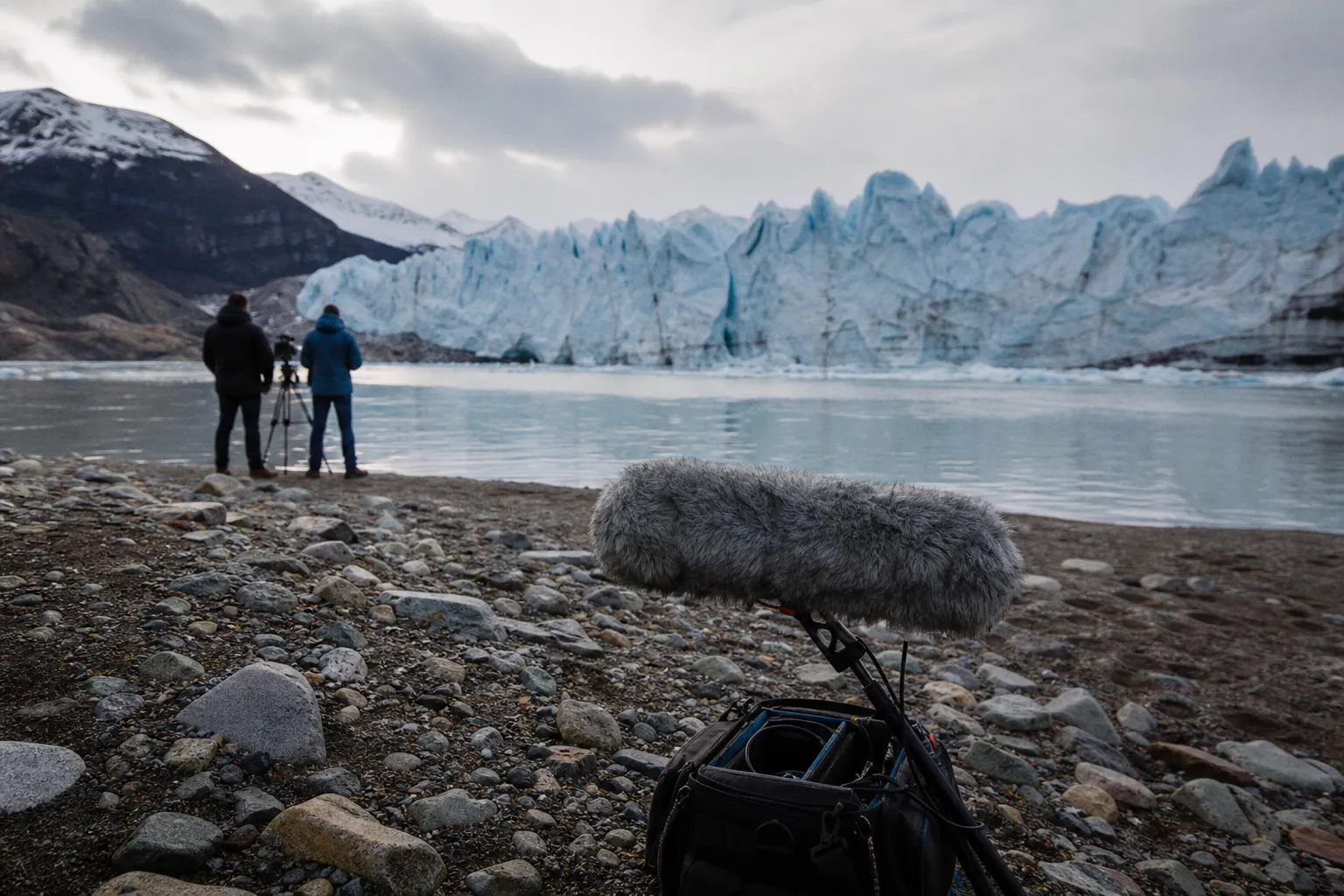
On an exterior dialogue scene, I usually want the shotgun close enough to maintain a strong direct-to-ambient ratio, angled to avoid reflective surfaces when possible, and protected by a proper windshield system rather than a decorative foam sleeve pretending to be weather gear. Wind does not care what the spec sheet promised. It will overload capsules, rumble through low frequencies, and chew up intelligibility before anyone notices on tiny camera headphones.
Placement is as important as pattern. A mediocre mic placed intelligently can beat a famous mic aimed lazily. The sweet spot is often just above frame, angled toward the sternum or upper chest rather than stabbed straight at the mouth, depending on the voice and movement. Aim too high and you collect forehead and air. Aim too low and clothing, footsteps, and ground reflections begin to intrude. Aim from the side and you may invite off-axis coloration into the performance.
Boom movement also has a sound. Fast cueing can create low-frequency handling noise. Poor shock mounts transmit little knocks that later masquerade as distant impacts. Loose cable loops slap the pole. A strong microphone will reveal these mistakes with painful honesty.
For documentary and run-and-gun work, I will often accept a slightly less refined tonal character if the mic is rugged, moisture-resistant, and forgiving of imperfect aim. For controlled narrative exteriors, I may favor a more precise, lower-noise microphone because the set gives the boom operator enough control to exploit it. For interiors, I question the shotgun immediately and reach for alternatives unless the room proves it can behave.
The real audition is not the showroom
Testing a shotgun microphone in a quiet shop tells you almost nothing. The mic needs to be heard against the kind of noise it will actually fight. Traffic has a different spectral shape from surf. Cicadas behave differently from generators. HVAC rumble lives in a different part of the spectrum from crowd murmur. The microphone’s rejection pattern interacts with each of these in ways that are not fully described by a polar chart.
When I audition a shotgun for a production, I want to hear:
1. A normal speaking voice at realistic boom distance, not a presenter talking six inches from the tube.
2. A quiet line, because self-noise and preamp quality show themselves when the actor drops intensity.
3. An off-axis noise source, preferably similar to the location problem we expect.
4. Movement across the pattern, because actors rarely freeze for the microphone’s convenience.
5. A damp or challenging exterior condition when relevant, because reliability is not theoretical on weather days.
The take I trust is the one that survives context. If a mic keeps dialogue intelligible without making the world sound chemically stripped, if it rejects enough without making off-axis sound grotesque, if it stays quiet under quiet speech and stable under moisture, then it has earned its place on the pole.
What “good” finally means
A good shotgun microphone is not merely directional. It is directional in a way that serves speech. It keeps transients crisp without sharpening them into pain. It lowers unwanted sound without replacing it with phase weirdness. It runs on dependable 48V phantom power through a proper recorder chain. It keeps self-noise low enough that intimate dialogue can breathe. It survives the weather the schedule refuses to respect.
Most of all, it is chosen with the location in mind. Outdoors, the interference tube can be a beautiful piece of acoustic engineering, giving the voice authority against a restless world. Indoors, that same tube can fight the room and lose in ways that no plugin can fully forgive.
I am protective of production sound because the audience is ruthless in the most honest way: they may forgive a rough image if the story holds, but they recoil when dialogue feels thin, smeared, noisy, or detached from the body speaking it. They do not name phase cancellation. They do not complain about polar response. They simply stop leaning in.
So choose the shotgun for the air it will hear, not the fantasy printed on the box. Put it close. Power it properly. Listen to the room before you trust the pattern. And when the take lands — clean consonants, low noise floor, stable tone, the actor’s breath sitting exactly where it should — the microphone disappears, which is the highest compliment sound can ever receive.